
In the past, many GPS devices relied primarily on the L1 frequency band; consequently, many early anti-GPS signal blockers were designed around a single GPS frequency.
However, the situation is now changing.
Modern GNSS receivers are no longer limited to a single frequency. Smartphones, drones, vehicles, and professional navigation systems increasingly support multiple GNSS signals.
What Are GPS Frequency Bands?
Navigation satellites transmit navigation signals through different frequency bands. Each band has different characteristics, and modern receivers may combine multiple signals to improve accuracy.
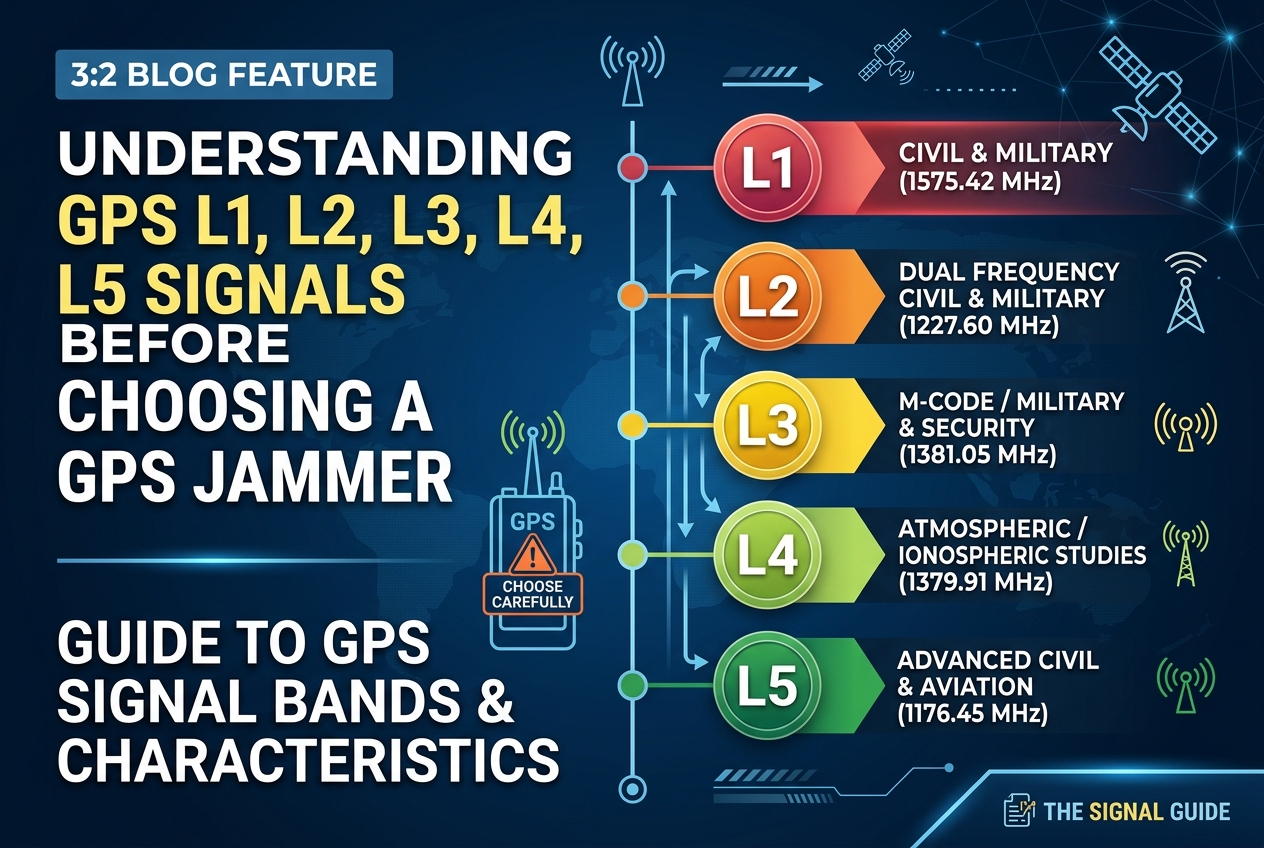
| Band | Frequency | Role in Navigation Systems | Importance for GPS Jamming Research |
|---|---|---|---|
| L1 | 1575.42 MHz | Traditional civilian GPS | Most common GPS signal |
| L2 | 1227.60 MHz | Dual-frequency positioning | Used in advanced receivers |
| L3 | 1381.05 MHz | Special applications | Limited consumer use |
| L4 | 1379.91 MHz | Research applications | Rare in commercial devices |
| L5 | 1176.45 MHz | Modern high-performance GPS | Increasing adoption |
GPS L1: The Most Common GPS Signal
GPS L1 is the original civilian GPS frequency and remains the foundation of most consumer navigation devices.
It operates at:
1575.42 MHz
It is widely used in: Smartphones; Vehicle navigation systems; Consumer GPS trackers; Portable navigation devices
Because of its widespread adoption, L1 remains one of the most discussed frequencies in satellite signal jamming analysis.
However, newer GNSS receivers are increasingly moving beyond L1-only operation. This is one reason why L1 remains an important reference point when discussing GPS jammer frequency coverage and how different receivers respond to GPS signal jamming.
GPS L2: The Move Toward Dual-Frequency GPS
GPS L2 operates at:
1227.60 MHz
The biggest advantage of L2 is that it allows receivers to compare signals from multiple frequencies.
This helps improve:
- Position accuracy
- Atmospheric error correction
- Professional navigation performance
Modern applications using L2 include: Survey equipment; Precision agriculture; Industrial positioning systems
As more receivers support L1/L2 combinations, GNSS signal environments become more complex than traditional single-frequency systems.
This also affects how GPS tracker blocker technology is evaluated, since modern receivers may process multiple satellite signals instead of relying on only one GPS band.
GPS L5: The New Generation Civilian GPS Signal
GPS L5 operates at:
1176.45 MHz
Compared with older positioning signals, L5 was developed for more advanced civilian applications.
It is increasingly supported by: New smartphones; Autonomous vehicles; Commercial drones; Professional GNSS receivers
The growth of L5 support shows that modern navigation receivers are becoming more dependent on multiple frequency signals rather than a single GPS band.
What Are GPS L3 and L4 Used For?
Compared with L1, L2, and L5, GPS L3 and L4 are less familiar to everyday users.
GPS L3
Frequency:
1381.05 MHz
L3 was developed mainly for specialized applications rather than consumer navigation.
It has historically been associated with government-related detection systems.
GPS L4
Frequency:
1379.91 MHz
L4 has mainly been used for research purposes, including studies related to atmospheric effects on GPS signals.
Unlike L1 and L5, these frequencies are not commonly found in consumer navigation devices.
Why Understanding GPS L1 to L5 Signals Matters Before Choosing a GPS Jammer
GPS is no longer built around a single signal. While L1 remains the foundation of most consumer GPS devices, newer receivers can combine multiple bands such as L2 and L5 to improve positioning performance in challenging environments.
This difference matters because a smartphone, a drone, and a professional navigation system may all use GPS but rely on different signal combinations. A receiver designed years ago may depend mainly on L1, while newer systems may process additional GPS frequencies for greater accuracy and stability.
By understanding the differences between GPS L1, L2, L3, L4, and L5, users can better understand how satellite signals are transmitted, received, and analyzed in today’s increasingly advanced GNSS landscape.