
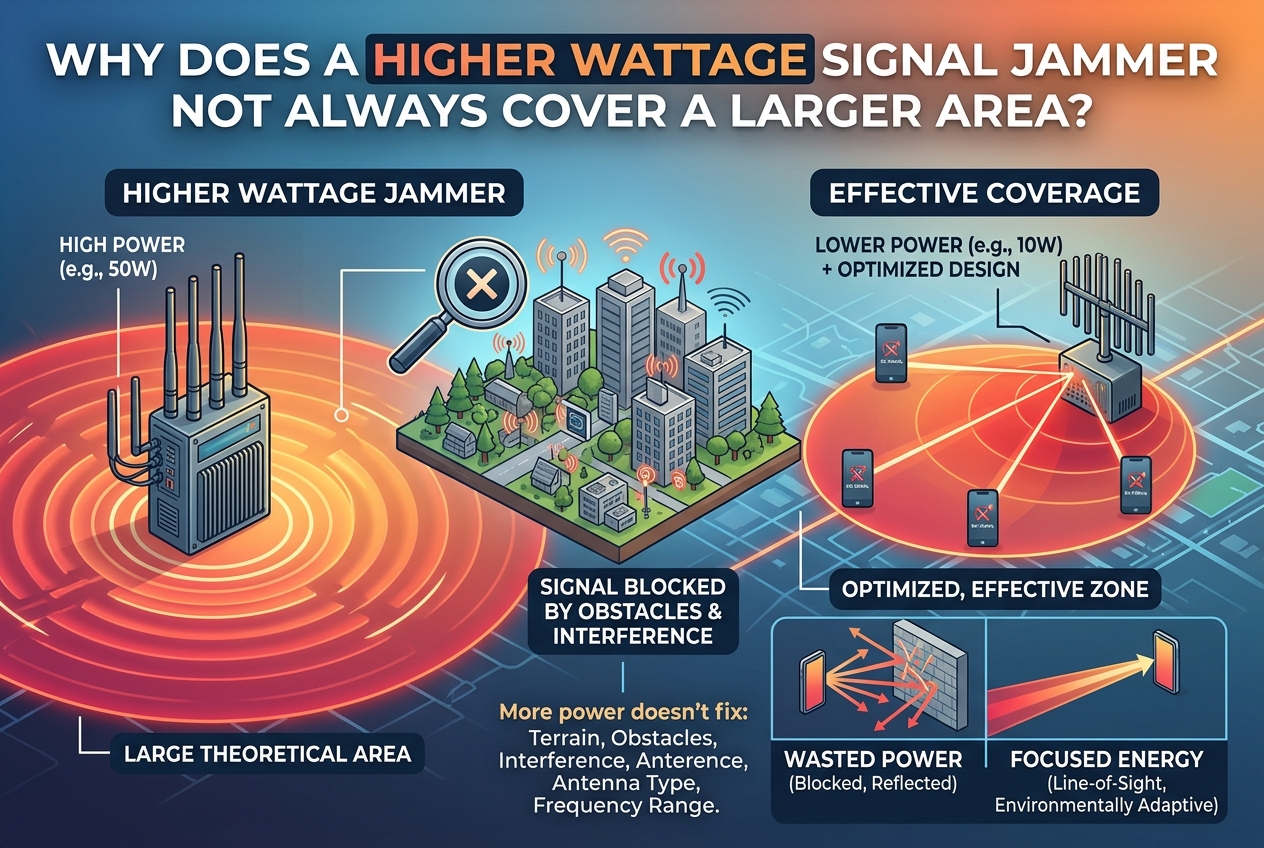
Many people assume that a higher power signal scrambler will automatically provide a wider coverage area. It sounds logical: more power should mean a stronger signal, and a stronger signal should travel farther.
However, wireless communication does not work that simply.
In real-world environments, the effective range of a signal blocker depends on several factors, including frequency coverage, antenna design, surrounding obstacles, signal strength in the area, and overall radio frequency performance.
A 30W jamming device is not guaranteed to outperform a 10W jamming device in every environment. Understanding why requires looking beyond a single specification.
Power Is Only One Part of Signal Coverage
Output power is an important specification, but it is only one element in the entire radio system.
Wireless transmission follows the basic principle that signals lose strength as they travel. This loss is affected by distance, frequency, obstacles, and antenna characteristics.
Engineers use a method called a “link budget” to estimate how signals behave by considering transmit power, antenna gain, distance, and environmental losses.
A simple way to understand this:
More power can increase signal strength, but it cannot remove every obstacle between the transmitter and receiver.
For example:
A high-power device placed inside a concrete office building may perform differently from a lower-power signal blocking device used in an open parking area.
The difference is not only the wattage — it is the environment.
The Difference Between Power and Real Coverage
Many product comparisons focus heavily on watts, but coverage depends on multiple technical factors.
| Factor | Why It Matters |
|---|---|
| Output Power | Provides the energy available for transmission, but does not determine range alone |
| Antenna Design | Affects how efficiently energy is distributed |
| Frequency Coverage | Different frequencies behave differently around obstacles |
| Environment | Buildings, walls, and materials can reduce signal strength |
| Nearby Signal Conditions | Strong local signals may affect performance |
| Thermal Design | Stable operation matters during extended use |
Why Antenna Design Can Matter More Than Additional Power
One of the most overlooked parts of wireless equipment is the antenna system.
Many users compare two wireless network jammers and only look at wattage. However, antennas determine how efficiently radio energy is distributed.
Antenna gain does not create additional power. Instead, it focuses available energy in a particular radiation pattern. For example, some antennas spread energy more evenly, while others concentrate it in specific directions.
This means:
- A device with better antenna matching may perform more efficiently.
- A multi-antenna system can provide broader frequency management.
- Antenna placement affects real-world performance.
Think of it like lighting:
A stronger bulb does not always create better lighting if the reflector design is poor.
Frequency Matters: Higher Power Cannot Ignore Physics
Modern smartphones do not rely on a single wireless band, today’s devices may use multiple communication technologies, including:
- Cellular networks
- WiFi
- Bluetooth
- GPS-related signals
Different frequencies behave differently.
Lower frequencies often experience less path loss over distance and may penetrate certain obstacles more effectively, although actual performance depends on the complete RF system; While higher frequencies can experience greater attenuation in certain environments. Wireless propagation is influenced by frequency, distance, and physical surroundings.
For this reason, comparing two equipments only by power level can create an incomplete picture.
Example:
A device operating across several relevant frequency ranges may provide more practical performance than a higher-power equipment designed around fewer bands
Why The Same Jammer Can Perform Differently in Different Locations
The same signal blocker can produce different results depending on where it is used. Wireless signals do not travel through every environment in the same way.
| Location | Typical Challenge |
|---|---|
| Downtown area | Dense wireless activity and stronger surrounding signals |
| Office building | Concrete walls, metal structures, and multiple indoor barriers |
| Open outdoor area | Fewer physical obstacles but longer distances between devices and receivers |
| Vehicle environment | Metal surfaces can create signal reflection and multipath effects |
For example, a internet jammer operating in an open outdoor area may experience fewer obstacles than the same device used inside a modern office building with concrete walls and metal structures.
What other factors should buyers consider?
| Specification | Why It Matters |
|---|---|
| Frequency Coverage | Determines supported signal ranges |
| Antenna Configuration | Influences signal distribution |
| Power Output | Provides transmission capability |
| Cooling Structure | Supports continuous operation |
| Operating Environment | Determines realistic expectations |