
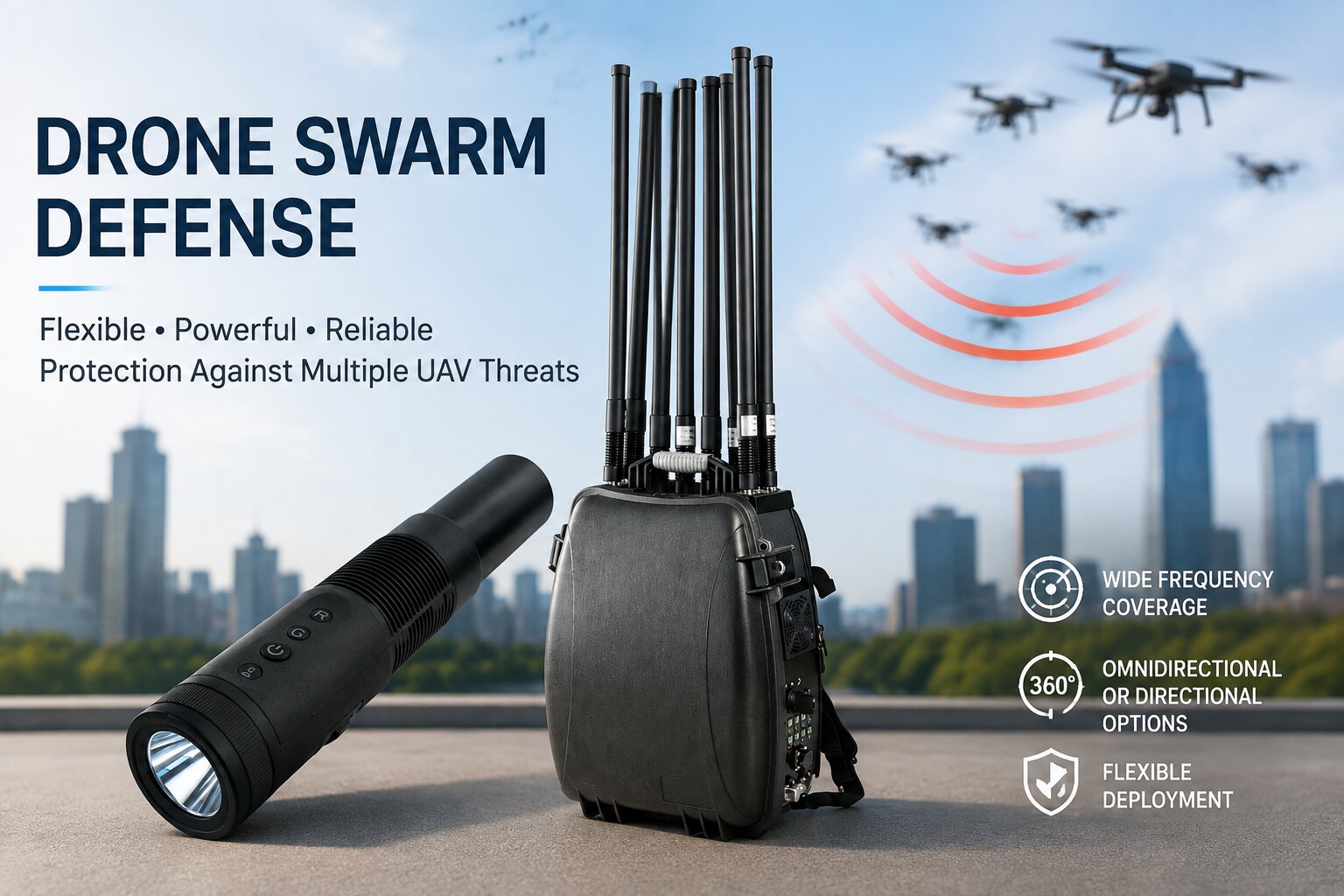
A drone flying over a restricted area is already a security concern. But a group of UAVs moving together creates a completely different challenge.
| Single Drone Scenario | Drone Swarm Scenario |
|---|---|
| One UAV target | Multiple UAV targets |
| Single control link | Multiple communication connections |
| Individual response | Area protection |
| Fixed approach path | Dynamic movement patterns |
This raises an important question: can a drone jammer handle a threat that involves multiple UAVs operating together?
From One Drone to Multiple Coordinated UAVs
A quadcopter is typically controlled by a single operator.
A drone swarm changes this model.
Multiple UAVs may operate through:
- Coordinated flight paths
- Shared communication networks
- Automated positioning
- Multi-node control systems
Instead of one signal connection, security teams may face multiple signal sources operating in the same area.
This creates a more complex RF environment, which means a FPV system signal blocker may need broader frequency coverage and better deployment flexibility when dealing with multiple UAVs.
Why Coverage Design Matters Against Multiple UAVs
One of the key factors in quadcopter defense is coverage.
Different environments require different coverage methods and antenna designs.
Some might assume that omnidirectional drone jamming devices are better than directional ones for dealing with quadcopter swarms, but this is not the case.
Omnidirectional Systems
Omnidirectional antennas distribute RF energy around the device.
Advantages:
Covers multiple directions
Suitable for changing quadcopter approach angles
Useful for mobile protection scenarios
Typical applications:
- Events
- Vehicles
- Temporary security zones
This can be useful when protection is focused on a specific perimeter or entry route.
Directional Systems
Directional antennas focus energy toward a specific area.
The Second-Generation Flashlight Quadcopter UAV Killer is a prime example.
Advantages:
Longer reach in a selected direction
More focused coverage
Suitable for known approach paths
Typical applications:
- Perimeter protection
- Fixed locations
- Long-distance monitoring areas
Omnidirectional antennas provide surrounding coverage, making them useful when UAVs may approach from unpredictable directions.
| Antenna Type | Best For |
|---|---|
| Omnidirectional | Multiple directions and mobile deployment |
| Directional | Focused long-range protection |
Neither design is universally better.
Why Mobility Matters in Drone Swarm Defense
Drone swarm activity is not limited to fixed locations. A threat may appear near temporary events, outdoor facilities, or changing operational areas.
This makes mobility an important factor when selecting UAV frequency blocker equipment.
Portable FPV system signal blocker systems become valuable when protection needs to move with the situation.
Key advantages include:
| Requirement | Why It Matters |
|---|---|
| Rapid deployment | Allows teams to establish protection in changing locations |
| Flexible positioning | Helps adjust coverage based on drone approach direction |
| Mobile operation | Suitable for vehicles, outdoor operations, and temporary security areas |
For drone swarm scenarios, mobility is not only about carrying a device. It is about having the ability to reposition protection when the airspace situation changes.
Why Drone Swarm Defense Requires a Layered Approach
The anti-drone jammer addresses the response stage, but quadcopter swarm situations often require earlier awareness because multiple UAVs may approach from different directions.
For one UAV, the process may be relatively simple:
Detect → Identify → Respond
A swarm requires more coordination:
Detect multiple targets → Analyze movement patterns → Select response methods → Continue monitoring
The reason is simple: multiple quadcopters may not follow the same route or create the same level of risk.
A layered counter-drone system combines different functions:
| Defense Layer | Purpose |
|---|---|
| Detection | Find UAV activity and identify potential threats |
| Analysis | Determine drone type, direction, and possible risk level |
| Response | Apply suitable countermeasures based on the situation |
| Monitoring | Confirm results and track remaining activity |
The reason is that a swarm creates more decisions than a single quadcopter. Security teams need to know not only where a UAV is, but also how many are present, which direction they are moving, and which response is appropriate.
So, a drone jammer can still play an important role, but drone swarm scenarios require the right equipment, coverage strategy, and deployment method.