
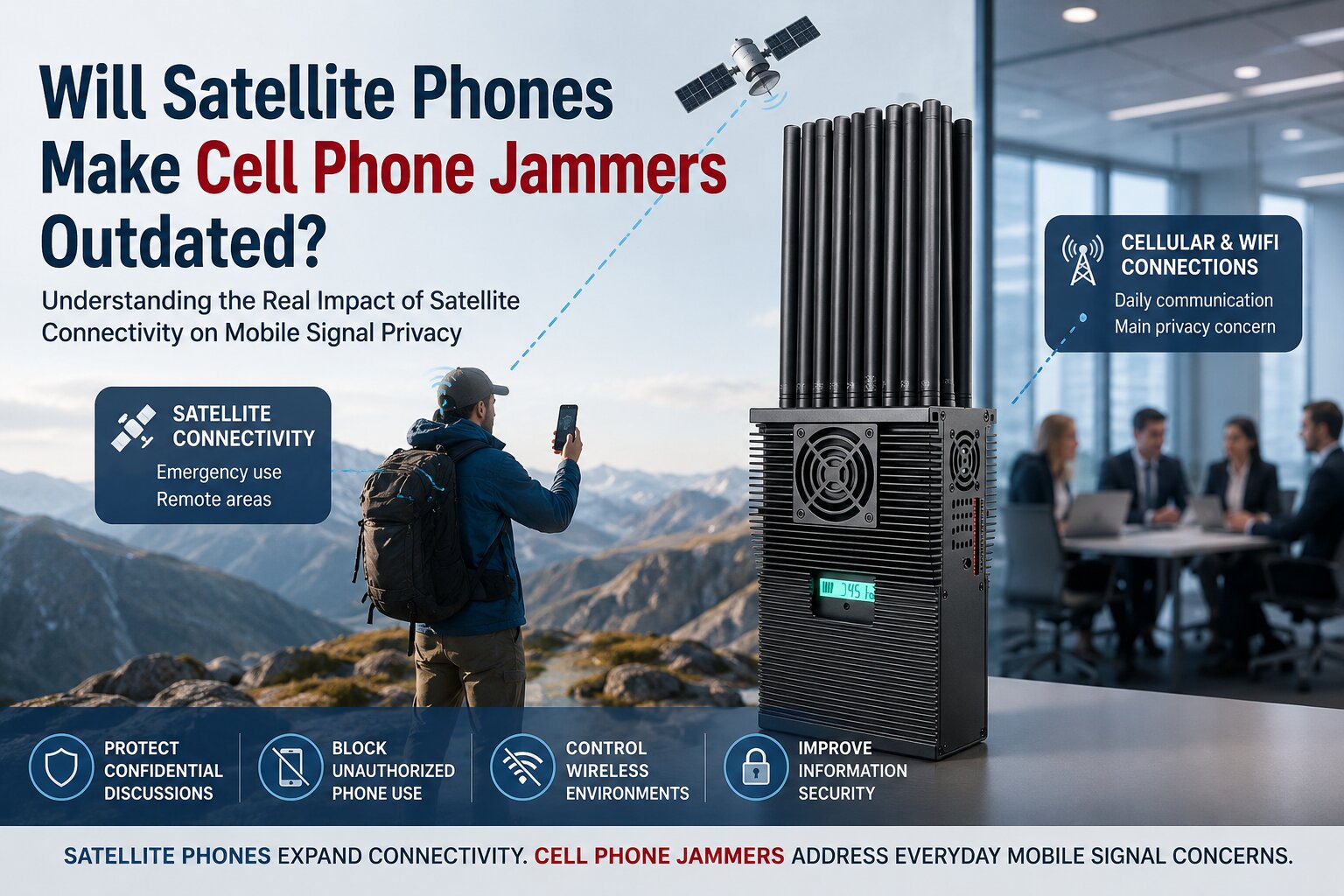
Satellite connectivity is no longer limited to specialized devices. Apple’s emergency satellite features and new satellite-to-phone projects such as Starlink Direct-to-Cell are bringing space-based communication closer to everyday smartphones.
This shift has raised an important question for privacy-focused users and businesses: will satellite phones make traditional mobile phone jammers outdated?
The answer is more complicated than a simple yes or no. Satellite communication changes how devices connect, but it does not remove the need for controlling sensitive wireless environments.
Satellite Smartphones:
Traditional smartphones normally communicate through nearby cellular towers.
The connection path looks like this:
For most Americans, daily communication still happens through traditional networks. People use 5G, WiFi, and fiber-connected services for work, entertainment, and personal communication.
This type of connectivity is currently focused on specific situations:
- Remote hiking areas
- National parks
- Disaster zones
- Emergency communication
- Locations with weak cellular coverage
Apple’s satellite services, available on newer iPhone models, are designed mainly for emergency messaging, roadside assistance, location sharing, and communication when traditional cellular or WiFi connections are unavailable.
This means satellite phones are expanding connectivity — not replacing normal mobile communication.
Why People Think Satellite Phones Could Challenge Mobile Network Blockers
The concern comes from a simple idea:
If phones can connect directly to satellites, will traditional wireless control methods become ineffective?
This question is reasonable because wireless technology is becoming more diverse.
In the past, mobile communication mainly involved:
GSM networks
3G
4G LTE
5G cellular bands
Today, the wireless environment includes:
Cellular networks
WiFi connections
Bluetooth devices
IoT networks
Space-based communication systems
The communication landscape is no longer a single network.
It is becoming a combination of multiple technologies.
Satellite Phones Do Not Replace Traditional Cellular Networks
One common misunderstanding is that space-Based Smartphones will completely replace cellular networks.
Current technology does not support that idea.
Satellite-to-phone services still have limitations:
| Feature | Traditional Smartphone Network | Satellite Smartphone Connection |
|---|---|---|
| Daily mobile use | Excellent | Limited |
| High-speed internet | Widely available | Still developing |
| Indoor performance | Strong | Challenging |
| Emergency messaging | Available | Major advantage |
| Remote areas | Limited by towers | Strong advantage |
Research into Starlink Direct-to-Cell technology shows that early deployments focus on extending coverage to underserved areas rather than replacing terrestrial networks.
Current satellite-to-device services are mainly designed around messaging and basic connectivity.
For example, a person hiking in a remote area of Montana may benefit from satellite messaging when there is no nearby cell tower. However, someone working in a Chicago office will still rely mainly on traditional cellular and WiFi networks.
For locations where mobile communication is of particular concern, such as offices and meeting rooms, consider using a similar P-US-J28 Portable 28-Band All-in-One Signal Jammer as part of a broader wireless privacy setup.
Satellite Phones Change the Signal Equation, Not Everyday Mobile Use
This technology changes one important factor: where a phone gets its connection from.
Traditional smartphones depend on terrestrial networks. A phone communicates with nearby cellular towers using licensed mobile bands. Most current 5G internet jammer discussions are based on these common cellular connections because they represent the majority of smartphone usage.
Satellite smartphones work differently. Instead of connecting directly to a nearby tower, the device communicates with a positioning system designed for coverage extension.
This difference matters, but only in specific situations.
For example:
| Scenario | Primary Connection | Impact on Cellular Phone Jamming Device Discussions |
|---|---|---|
| Office meeting | 4G/5G/WiFi | Traditional mobile signals remain the main concern |
| Business travel | Cellular networks | Everyday smartphone communication still depends on towers |
| Remote hiking area | Satellite messaging | Remote connectivitybecomes more relevant |
| Emergency response | Satellite services | Communication priority is availability |
A person using an iPhone satellite emergency feature in a remote area is solving a coverage problem. A company protecting a confidential meeting is dealing with a completely different issue — controlling wireless activity inside an existing communication environment.
These are two separate use cases.
Why Satellite Connectivity Does Not Eliminate Cellular Signal Concerns
he biggest misunderstanding about satellite smartphones is assuming they will replace all existing mobile connections.
In reality, these services currently focus on limited functions such as:
- Emergency messaging
- Location sharing
- Basic communication in remote areas
They are not designed to replace the high-volume daily activities handled by cellular networks, including:
Mobile internet browsing
Video calls
Business applications
Cloud services
Standard phone communication
For this reason, the demand for mobile cell scrambler devices remains closely connected to how people use smartphones in normal environments.
A conference room in Dallas, a corporate office in San Francisco, or a private facility in Washington D.C. is still filled with cellular and wireless devices — not satellite-only connections.
The Real Impact of Satellite Phones on Cell Phone Jammer Technology
These devices introduce a different way for smartphones to connect, but they do not make traditional anti jamming device for smartphone outdated.
The reason is simple: space-based communication and everyday mobile communication serve different purposes.
Satellite-based smartphone services are mainly designed for situations where traditional cellular coverage is unavailable, such as remote travel, emergency response, and disaster recovery. In contrast, most smartphone activity in the United States still depends on 4G LTE, 5G, and WiFi networks used in offices, homes, vehicles, and public spaces.
| Communication Type | Primary Purpose | Connection to GSM Signal Blocker Discussions |
|---|---|---|
| 4G LTE / 5G | Daily calls, messages, mobile data | Main area of smartphone signal management |
| WiFi | Internet access and connected devices | Common wireless environment |
| Remote connectivity | Remote communication and emergency use | Specialized communication method |
A person using satellite messaging while hiking in a remote area is solving a connectivity problem. A business protecting confidential discussions in a meeting room is dealing with a different situation involving everyday wireless devices.
For this reason, these devices are unlikely to make mobile sim network blockers outdated. Instead, they represent another communication method alongside existing cellular networks.
The future of mobile communication will not be defined by satellites replacing cellular technology, but by different connection methods being used for different needs.