
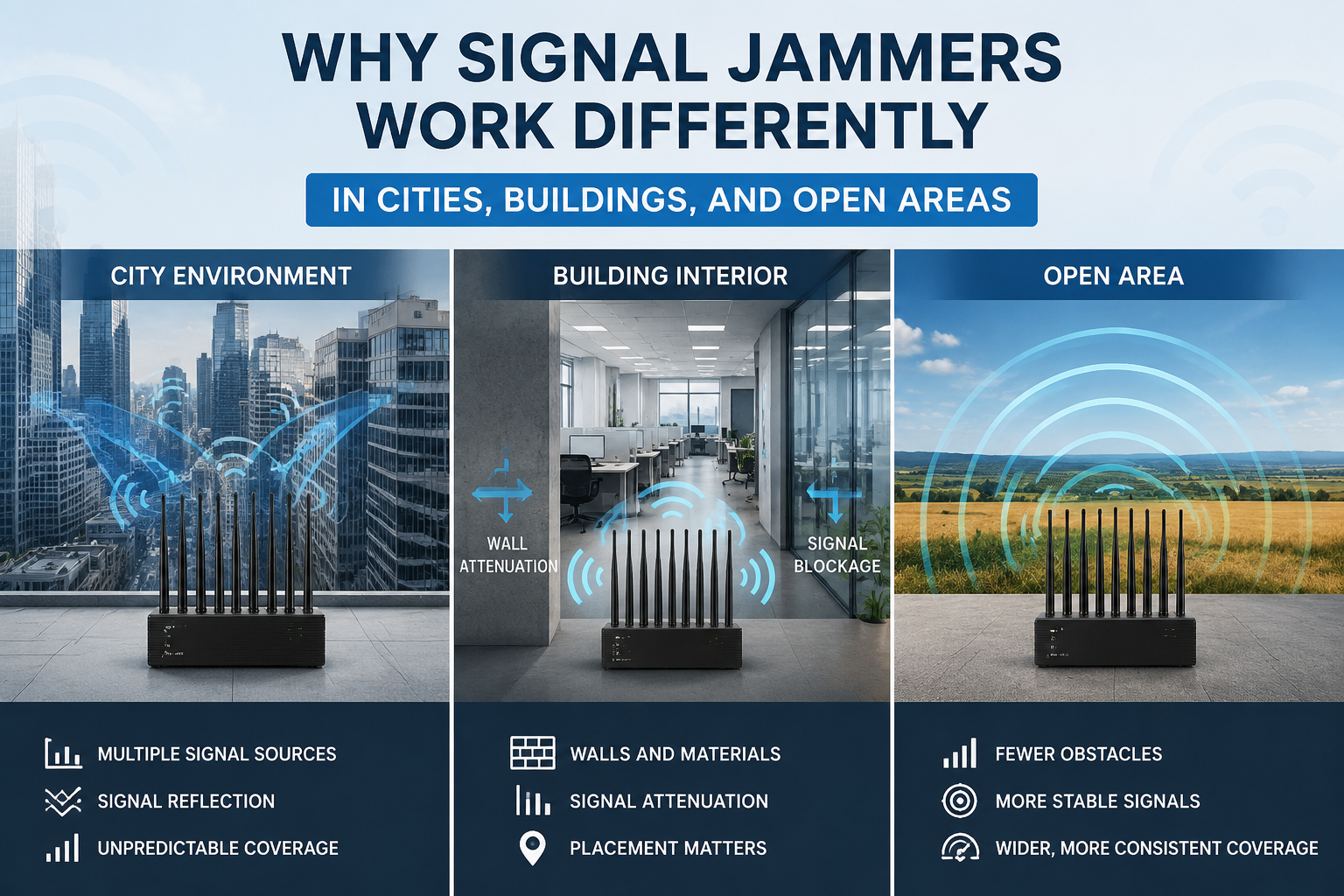
Why does a signal blocker reach farther in one location but struggle in another?
The answer is not only output power. Wireless signals are affected by everything around them — from concrete walls and glass windows to nearby transmitters and antenna placement.
The Same Jammer, Different Environment
A signal suppressor does not work against a fixed signal level. The surrounding wireless environment changes from one location to another.
For example:
| Location | Common Factors Affecting Performance |
|---|---|
| City area | Dense buildings, multiple signal sources, reflections |
| Office building | Concrete walls, glass panels, metal structures |
| Warehouse | Large spaces, metal surfaces, open layouts |
| Outdoor area | Few obstacles, clearer signal paths |
A frequency blocker used near a busy urban area may face stronger and more complicated signals than one used in a quiet outdoor location.
Why Cities Create More Signal Challenges
Cities are filled with wireless activity.
Cell towers, WiFi networks, smart devices, and other transmitters create a crowded signal environment.
Buildings can also reflect wireless signals, causing them to travel through multiple paths instead of a direct line.
How Buildings Change Signal Performance
| Building Material | Effect on Wireless Signals |
|---|---|
| Concrete | Reduces signal penetration |
| Reinforced concrete | Stronger blocking effect due to metal reinforcement |
| Glass | Allows more signal transmission |
| Metal structures | Can reflect or distort signals |
A signal blocking equipment inside a concrete office may behave differently from the same device placed near large glass windows or inside a metal warehouse.
Placement also matters. Moving a device only a few feet can sometimes change the surrounding signal conditions.
Why Open Areas Usually Produce More Predictable Results
Open spaces remove many obstacles.
Without thick walls, metal structures, or nearby reflections, wireless signals generally travel more directly.
Actually, ample space does not guarantee optimal performance. Distance from signal sources, frequency bands, and antenna height still influence results.
Frequency Bands Matter
Different wireless frequencies respond differently to obstacles.
| Frequency Range | General Behavior |
|---|---|
| Lower frequencies | Travel farther and penetrate obstacles better |
| Mid frequencies | Balanced coverage and penetration |
| Higher frequencies | More affected by walls and distance |
Antenna Position Can Change Coverage
Output power is only one part of performance.
Antenna design and placement also affect how signals spread.
Important factors include:
- antenna height
- surrounding obstacles
- installation position
- antenna direction
For example, placing a device behind large objects or close to metal surfaces may change the coverage pattern.
Choosing the Right Signal Jammer for the Environment
The best results come from matching the device to the location.
| Application | Common Choice |
|---|---|
| Temporary use | Portable signal blocker |
| Fixed indoor location | Desktop signal suppressor |
| Vehicle installation | Vehicle-mounted signal jamming device |
| Larger outdoor areas | Higher-power systems |
A device designed for a small indoor space may not deliver the same results in a large open area, and a high-power system may be unnecessary for a small room. We recommend that you purchase the Indoor Wireless Frequency Jammer category.
Final Thoughts
A city apartment, office building, warehouse, and open field create completely different operating conditions.
Signal jammer performance depends on more than power ratings. Location, construction materials, wireless activity, and antenna placement all influence the final result.
“Not sure which device is right for you? Contact us — our team will help you choose the right solution based on your needs.”