
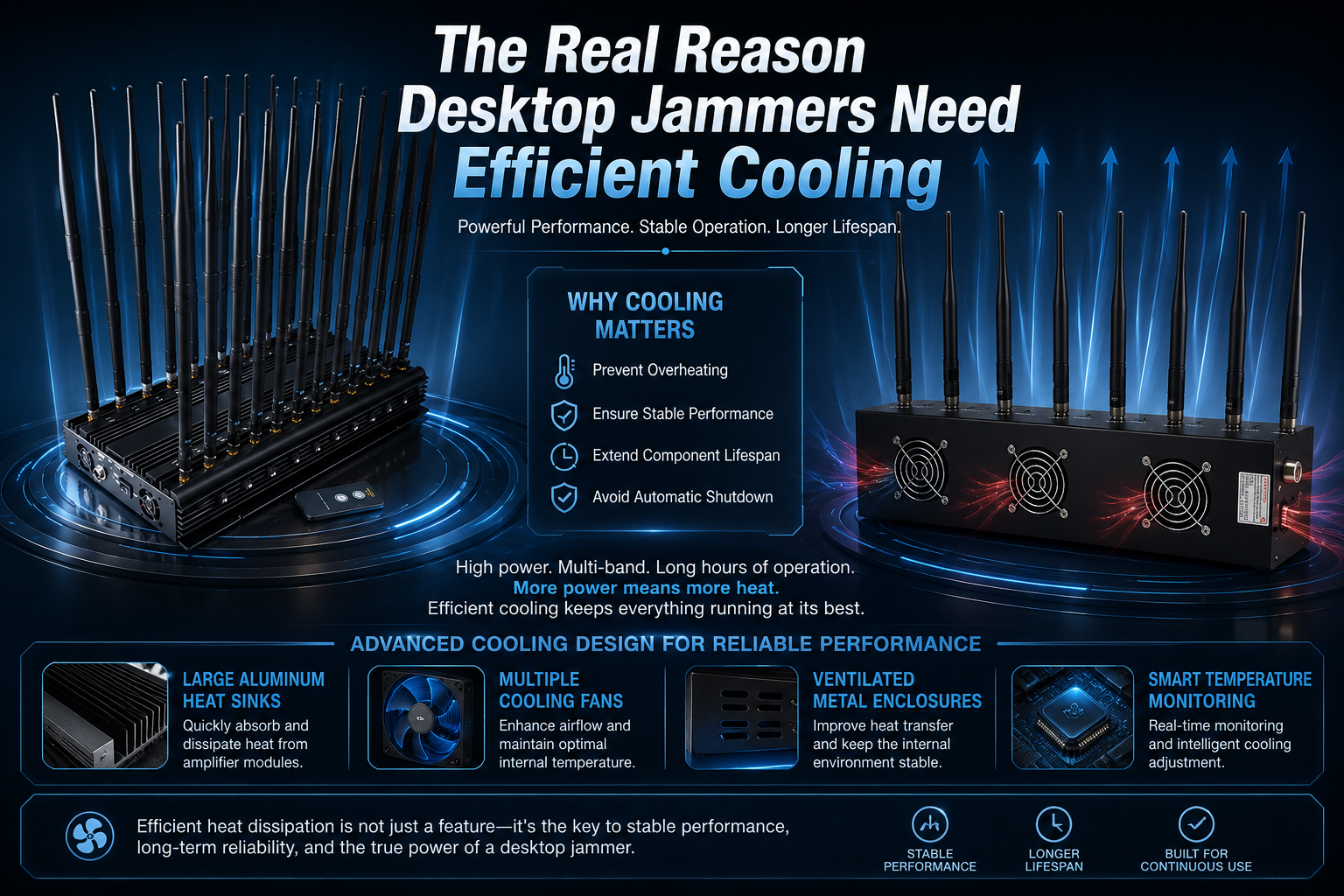
Many first-time buyers focus on one thing when choosing a desktop jamming device: power. The logic seems simple. More power means wider coverage and stronger signal blocking capability.
But experienced users often pay attention to something else entirely—the cooling system. In reality, cooling is one of the most important factors affecting the performance, stability, and lifespan of a large stationary signal blocker.
So why do desktop radio network jammers require advanced cooling systems?
1.The More Frequencies a Jamming device Covers, the More Heat It Produces
There is a reason why many high-power jammers for electronic device are built as desktop units. Unlike portable models, they are expected to handle multiple wireless frequencies simultaneously, from cellular and WiFi signals to GPS, Bluetooth, and drone communication bands.
Behind every supported frequency is a dedicated set of electronic components working continuously. As the number of active bands increases, so does the amount of heat generated inside the suppressor, making effective cooling a critical part of the overall design.
2.Power Amplifiers Are the Main Heat Source
Inside every stationary signal blocker are power amplifier modules, these components are responsible for generating the radio frequency energy required for signal interference.
However, no amplifier is perfectly efficient, part of the electrical energy becomes RF output, the remaining energy turns into heat.
When several amplifier modules operate simultaneously, internal temperatures can rise quickly. This is especially true for stationary jamming devices designed for continuous operation.
3.Why Portable Jamming Equipment Don’t Face the Same Challenge
Many users wonder why large desktop signal blockers need cooling fans while portable models often rely on simpler designs, the answer is straightforward.
- Portable Jammers
- Lower output power
- Fewer frequency bands
- Short operating periods
- Battery-powered design
- Desktop Jammers
- Higher transmission power
- More frequency coverage
- Longer operating time
- Continuous power supply
A stationary signal blocker may run for hours without interruption, that creates a completely different thermal environment.
4.What Happens When Cooling Is Insufficient?
Heat does more than make the enclosure feel warm, excessive temperatures can affect internal components in several ways:
Reduced Stability: High temperatures may cause performance fluctuations during long operating periods.
Shorter Component Lifespan: Electronic components generally age faster when exposed to excessive heat.
Increased Maintenance Requirements: Constant thermal stress can place additional strain on internal hardware.
Automatic Protection Shutdowns: Some devices include thermal protection systems that reduce power or shut down when temperatures become too high.
How Modern Stationary Signal Blocker Manage Heat?
Manufacturers use several methods to keep temperatures under control.
- Large aluminum heat sinks
These absorb heat from amplifier modules and distribute it across a larger surface area.
- Multiple cooling fans
Instead of relying on a single fan, many desktop suppressor use multiple fans to improve airflow.
- Ventilated Metal Enclosures
Metal housings help transfer heat away from critical components while allowing hot air to escape.
- Smart Temperature Monitoring
Some advanced models include temperature sensors that automatically adjust cooling performance when needed.
For example, our T-US-022 – 22 Antennas Stationary all in one Jamming Device, which uses a high-efficiency aluminum alloy heat sink and 5 built-in fans to ensure stable machine operation, thereby reducing the risk of overheating during equipment operation. There’s also the T-US-018-1 High Power desktop 5G Jamming device, whose surface features a striped design, along with built-in ultra-thick heatsinks, ventilation holes, and a fan, effectively reducing heat buildup.
Why Bigger Isn’t Always Better
A larger desktop silencer often means more antennas, higher output power, and broader frequency coverage. However, these advantages also generate more heat inside the device.
Without an effective cooling system, increased power does not always translate into stable long-term performance. This is why modern stationary jammers are designed with thermal management in mind, ensuring that power and heat remain properly balanced.
Choosing a Desktop Jammer: Don’t Ignore the Cooling System
When comparing stationary frequency blocker , buyers often look at:
✓ Frequency coverage
✓ Antenna quantity
✓ Output power
✓ Signal range
While these specifications matter, cooling is equally important. A well-designed cooling system helps maintain stable operation, especially during extended use, and can contribute to the overall durability of the device.
Final Thoughts
The best desktop Jamming equipment is not simply the one with the highest power rating. In many cases, reliable performance depends just as much on effective heat dissipation as it does on output power.