
For decades, digital security has focused on protecting passwords, accounts, and online data. But artificial intelligence has introduced a new type of personal information that many people never considered: the human voice.
Your sound is no longer just a way to communicate. It can become a digital fingerprint containing unique characteristics such as tone, speaking patterns, and personal expressions.
Now, highly realistic synthesized speech can be generated with just a small audio sample.
The question is no longer only “Who can hear my conversation?”
Instead: “Who can collect my sound data and what can they do with it?”
So how should I prevent this?
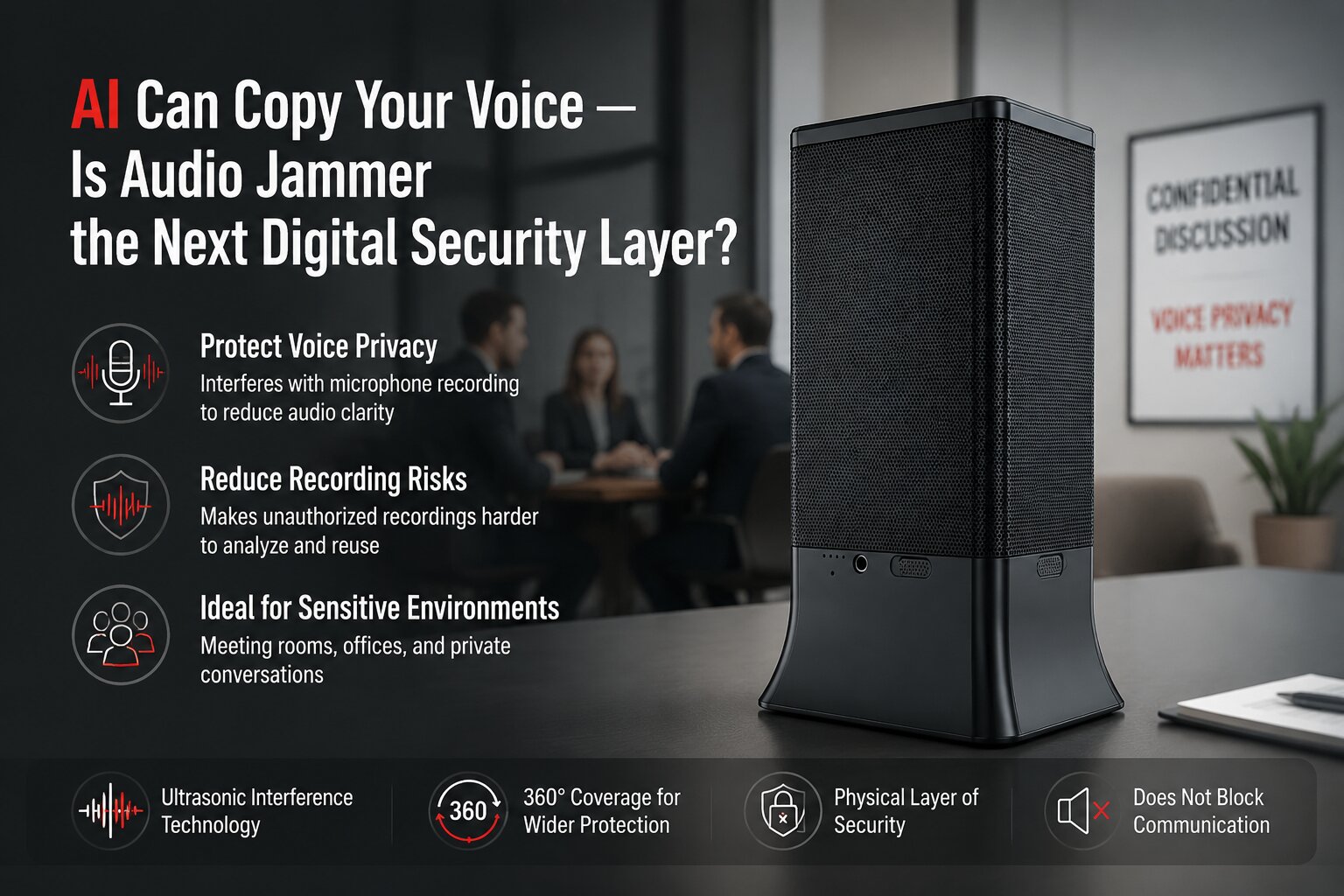
The answer is simple. Audio jammers provides an extra layer of protection against unauthorized voice recording.
A person’s voice contains more information than simple words.
Modern AI systems can analyze:
| Sound Element | Why It Matters |
|---|---|
| Tone and pitch | Helps recreate a person’s speaking style |
| Pronunciation habits | Creates a more realistic voice model |
| Emotional patterns | Make the generated speech sound more natural |
| Background conversations | May reveal private or business information |
Unlike a password, a sound cannot simply be changed after exposure.
If a password is leaked, users can reset it. If a voice sample is collected and used for AI modeling, removing that information becomes much more difficult.
AI Voice Copying Changes the Threat Model.
Traditional recording risks were relatively straightforward:
Someone records a conversation → private information is exposed.
AI introduces a different possibility:
Someone collects sound samples → AI creates a reusable voice model.
The concern is not only the information contained in a conversation.
The sound itself becomes valuable data.
Potential risks include:
- Fake voice messages appearing to come from trusted individuals
- Unauthorized collection of confidential discussions
- Exposure of business conversations
- Misuse of publicly available voice recordings
The Moment Before Data Exists Is Becoming a Security Concern
Most security strategies begin when information already exists in digital form. AI voice technology introduces a different question: what happens before information becomes data?
Audio Jammer: A Different Layer of Security
Instead of protecting stored information, it focuses on the environment where conversations happen.
| Security Area | Traditional Protection |
|---|---|
| Computer systems | Firewall and endpoint security |
| Buildings | Access control systems |
| Documents | Locked storage |
| Conversations | Voice privacy technologies |
In this context, a digital signal blocker to jam voice recording can be considered a physical security layer, effectively reducing the risk of unauthorized access to audio.
It does not replace cybersecurity.
It addresses a different stage of the security process.
How Anti Recording Device Works Against Voice Recording Risks?
An anti listening device does not block communication or change the conversation itself. It targets the recording process.
The device produces specific sound interference that affects how microphones capture sound. When a recording device receives the interference together with human speech, the microphone may struggle to separate the actual voice from the unwanted signal.
This makes the recorded audio harder to analyze, understand, or use for voice processing.
It’s worth noting that we generally recommend devices like the 360° Ultrasonic Anti-Recording Spy Bugs Jammer, which offers omnidirectional shielding.
The reason is simple: conversations do not always happen directly in front of a recording device. Smartphones, hidden microphones, and other audio capture devices may be placed at different locations within a room.
Is Voice Jammer the Next Digital Security Layer?
The answer is not that an signal blocker for videoke replaces existing cybersecurity methods.
Instead, it covers a different security gap — protecting spoken information before it becomes usable digital data.