
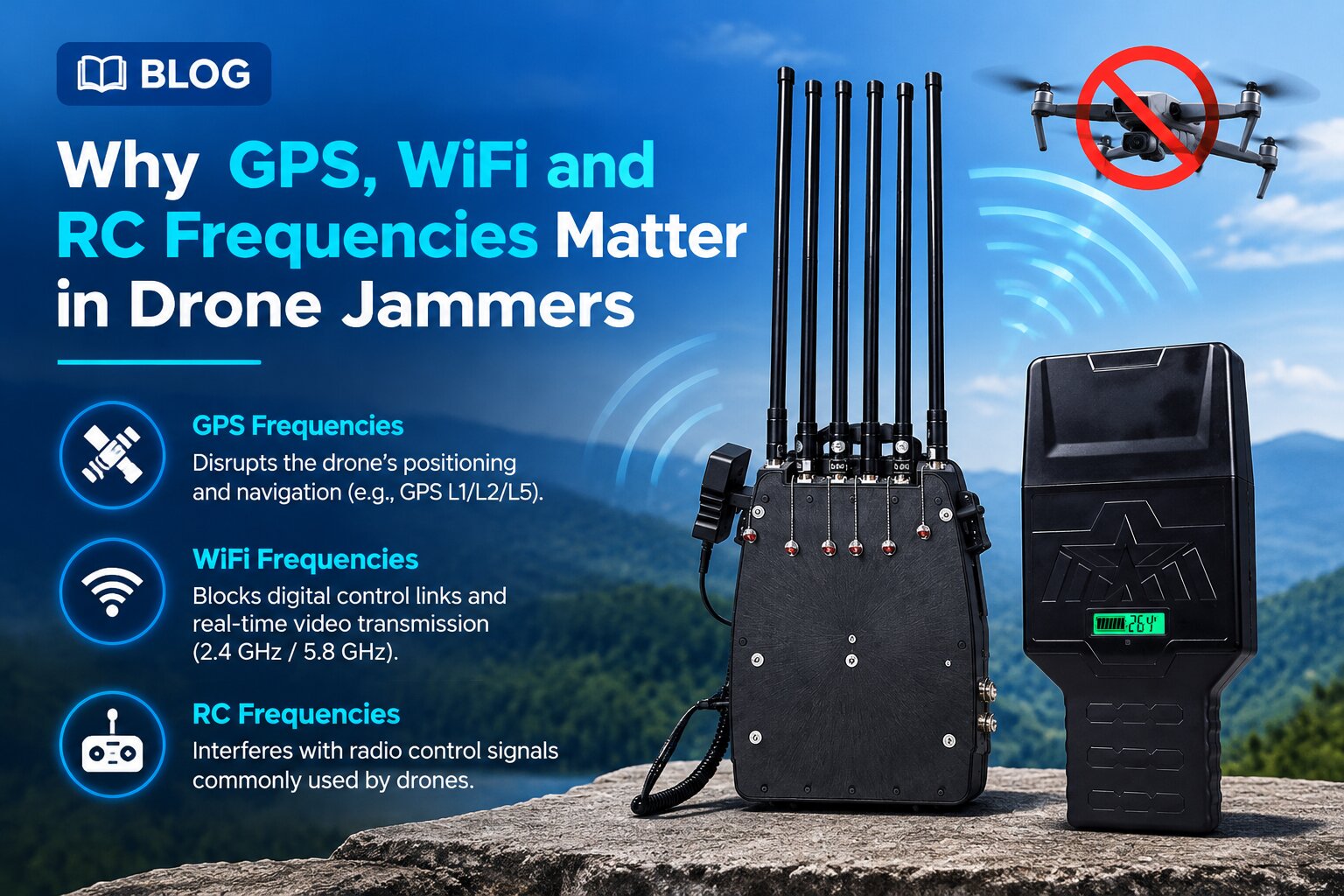
A drone flying over a backyard, a construction site or an open field relies on more than its motors and battery. Drones use different wireless signals for navigation, flight control and data transmission.
These signals operate across different frequency ranges, so a quadcopter UAV jammer may support several bands rather than a single frequency.
GPS, WiFi and RC serve different roles in drone operation. GPS supports satellite-based positioning, WiFi may handle wireless data or video connections, and RC carries commands between a controller and an aircraft.
GPS Frequencies: Supporting Navigation and Positioning
GPS helps a compatible drone calculate its position using signals transmitted by satellites. Depending on its flight system, that positioning data may support navigation, route planning, position hold and return-to-home functions.
The GPS system includes civilian signals at three key frequencies:
| GPS Signal | Nominal Frequency | General Role |
|---|---|---|
| GPS L1 | 1575.42 MHz | Widely used civilian positioning signal |
| GPS L2 | 1227.60 MHz | Used by compatible receivers for additional navigation measurements |
| GPS L5 | 1176.45 MHz | Modern civilian signal designed for demanding applications |
For example, a drone flying a preplanned route may rely on satellite positioning to estimate where it is along that route. If its navigation inputs become unreliable, the aircraft may respond differently depending on its flight controller, sensors and configured failsafe behavior.
WiFi Frequencies: Wireless Connections and Video Links
WiFi is familiar from home routers, smartphones and laptops, but similar frequency ranges can also appear in drone communication systems.
Some consumer drones use WiFi-based connections, while others rely on proprietary radio technologies.
| Frequency Range | Common Applications | What to Know |
|---|---|---|
| 2.4 GHz | WiFi, Bluetooth, and some drone control or data links | Widely used across consumer electronics |
| 5.2 GHz | Certain WiFi implementations and wireless systems | Support depends on the device and applicable regional rules |
| 5.8 GHz | WiFi, some drone links, and FPV equipment | Not every drone uses this range for the same purpose |
| 6 GHz | WiFi 6E and WiFi 7 equipment that supports the band | Not a universal drone communication frequency |
This variety explains why WiFi frequency coverage is a key detail in a anti-drone signal blocker’s specifications. Support for 2.4 GHz does not automatically mean that 5.2 GHz or 5.8 GHz is included. The listed frequency ranges need to be checked individually.
RC Frequencies: The Link Between the Pilot and the Drone
RC stands for remote control. The RC link carries commands from a handheld controller or ground station to the aircraft. Depending on the system, it may use 2.4 GHz, another radio band, or a proprietary communication protocol.
This link has a different purpose from GPS. GPS provides positioning information; the RC link carries flight commands. A drone may also use a separate channel or integrated system for telemetry and video.
Consider an FPV drone flying through an open field. The pilot needs a responsive control link, while the video feed provides a view from the aircraft. Both are important to the flying experience, but their technical requirements are not necessarily identical.
How GPS, WiFi and RC Bands Shape Drone Jammer Configurations
FPV system signal blockers differ in the frequency bands included in their hardware.
Such as, handheld 3 bands UAV jammer combines GPS L1 with 2.4 GHz and 5.8 GHz outputs.
While backpack portable 6 bands drone Jammer add 5.2 GHz and dedicated RC bands such as 433 MHz and 915 MHz.
These combinations give each model a distinct frequency configuration, reflected in its channel count and overall output power. For example, a unit with separate 433 MHz and 868 MHz channels has a different configuration from one that concentrates on GPS and WiFi-related bands.