
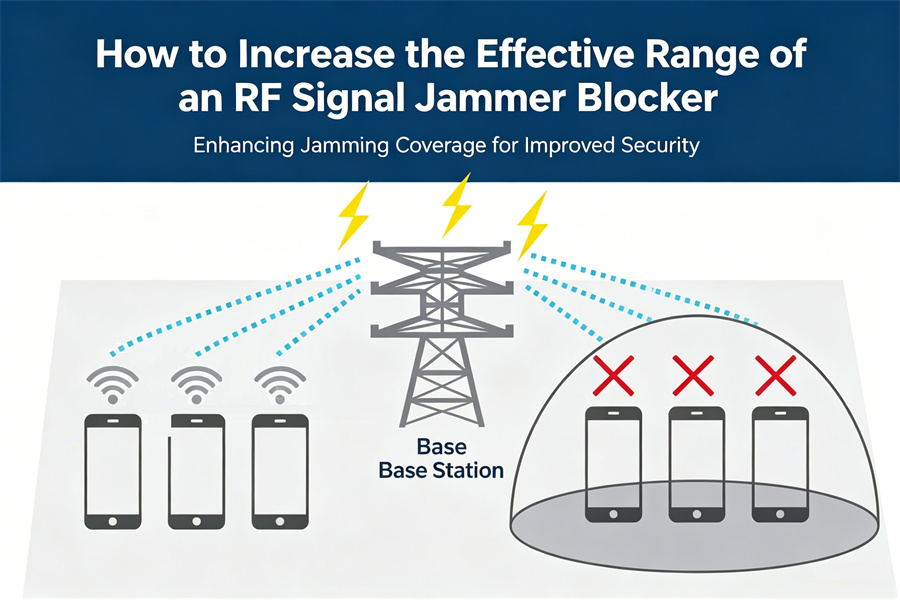
The performance of an RF Signal Jammer for electronic devices is not determined by output power alone. Many users assume that stronger wattage automatically means longer blocking distance, but real-world signal suppression depends on multiple technical factors working together.
In practical deployment, antenna efficiency, environmental conditions, heat management, and frequency targeting often have a bigger impact than raw power figures.
A well-optimized jammer can outperform a higher-power device with poor antenna design or unstable thermal control.
What Actually Affects signal blocker device Range?
1. Output Power Matters — But Only to a Certain Point
Increasing transmission power is the most direct way to expand signal suppression distance. A higher-power signal jamming device can generate stronger interference against surrounding wireless signals.
However, excessive power introduces new problems:
- Higher heat generation
- Reduced stability during long-term operation
- Greater unwanted interference outside the target area
- Faster battery drain in portable systems
A poorly cooled high-power jammer devices may actually perform worse after extended use due to thermal throttling.
2. Antenna Design Has a Huge Impact on Real Performance
Many low-cost frequency blocker focus heavily on output power while ignoring antenna efficiency.
In reality, antenna quality directly affects:
- Signal propagation efficiency
- Coverage consistency
- Directional accuracy
- Frequency stability
High-gain antennas can significantly improve blocking performance without requiring additional transmission power.
Directional vs Omni-Directional RF Signal Jammer Blocker Systems
Directional antennas concentrate interference toward a specific area, increasing effective range in the target direction.
Omni-directional antennas distribute energy equally in all directions, which provides wider coverage but lower concentrated intensity.
Directional jammers often achieve longer real-world blocking distances with the same output power.
3. Frequency Matching Is More Important Than Many Users Realize
Different wireless systems use different frequencies, bandwidths, and modulation methods.
A professional RF Signal Jammer Blocker performs best when its interference profile closely matches the target signal.
For example:
- 5G networks require different suppression strategies than GSM
- WiFi 2.4GHz behaves differently from WiFi 5GHz
- GPS signals are weaker and require precise frequency targeting
Wide-band interference may seem powerful, but focused frequency suppression is often more efficient.
4. Smart Signal Processing Improves Efficiency
Modern RF systems increasingly rely on intelligent signal management rather than brute-force transmission power.
Some advanced jammer platforms use:
- Adaptive signal targeting
- Frequency-specific optimization
- Selective band control
- Independent power adjustment per channel
This allows the device to maintain effective blocking while reducing unnecessary energy consumption.
Selective interference is often more efficient than attempting to overpower every nearby frequency simultaneously.
Environmental Factors Can Dramatically Change Jamming Distance
Buildings, Obstacles & Signal Reflection
Wireless signals behave differently depending on the environment.
Walls, glass, metal surfaces, elevators, and reinforced concrete can all affect radio propagation.
In some indoor environments:
- Signal reflections can unintentionally strengthen interference
- Dense structures may reduce effective coverage
- Open areas often allow wider propagation
Even the placement angle of the antenna can noticeably influence real-world performance.
Installation Positioning Matters More Than Expected
Correct placement can improve jammer efficiency without increasing power.
For better signal coverage:
- Position antennas above large obstacles
- Avoid enclosed metal cabinets
- Maintain airflow around cooling systems
- Use directional antennas toward the target area
Proper positioning is one of the simplest ways to improve RF blocking performance.
Why Cooling Systems Are Critical for Long-Range Signal Jammer Blocker Devices
Heat is one of the biggest hidden enemies of signal stability.
As internal temperatures rise:
- Output efficiency decreases
- Frequency drift may occur
- Power modules become unstable
- Long-term performance declines
Professional-grade systems often include:
- Large aluminum heat sinks
- Multiple cooling fans
- Ventilation channels
- Independent RF modules
Stable cooling is one of the key differences between entry-level and professional RF jamming systems.
Final Thoughts on Maximizing RF Signal Jammer Blocker Performance
Extending jammer range is not simply about increasing wattage.
The best-performing systems combine:
- Efficient antenna design
- Stable thermal management
- Accurate frequency targeting
- Smart signal control
- Proper installation positioning
The most effective RF Signal Jammer Device is not always the most powerful one — it is the one optimized as a complete system.