
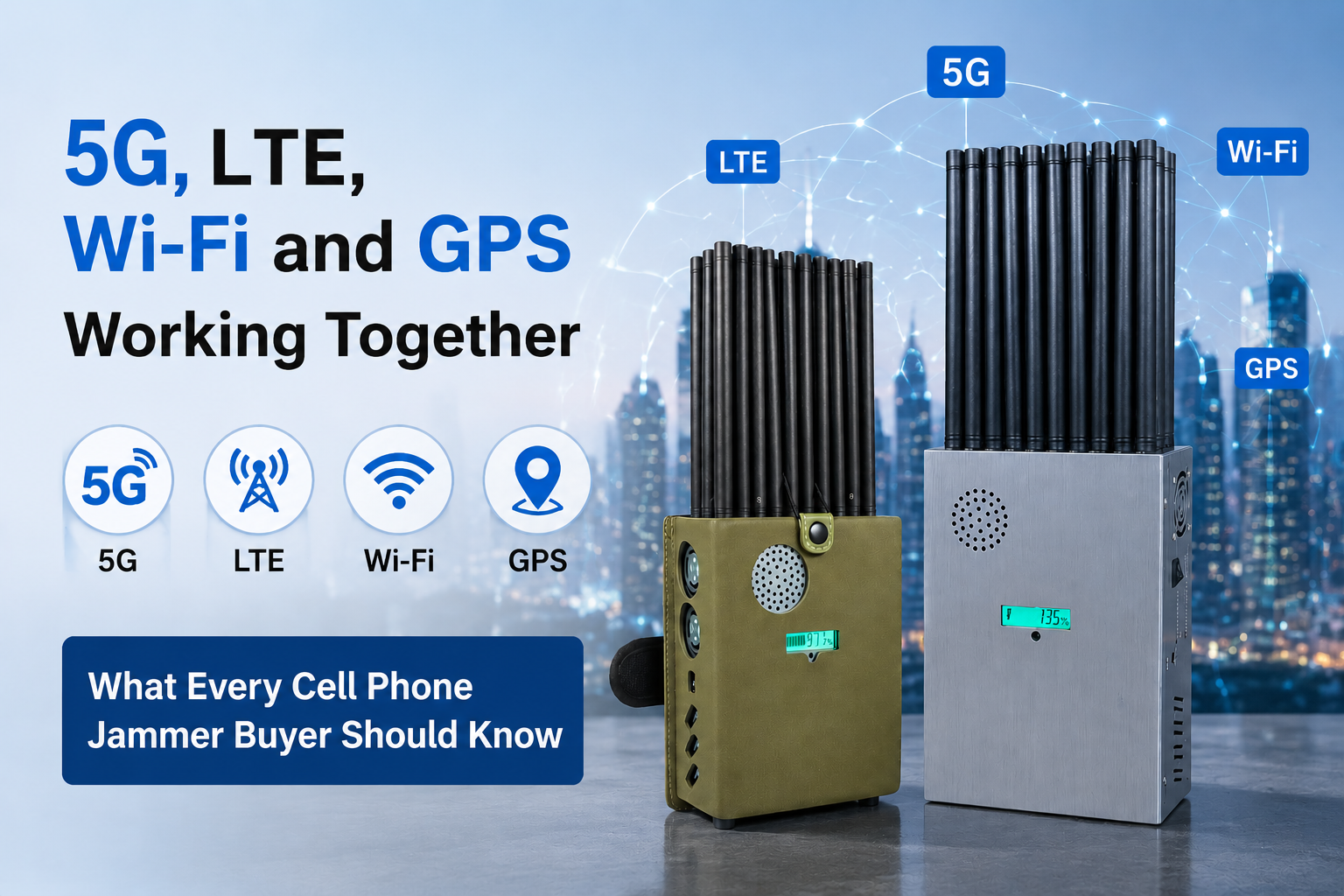
A smartphone rarely stays connected to just one wireless network anymore.
A call may start over a 5G connection, switch to LTE when coverage changes, connect to Wi-Fi indoors, while GPS continues working quietly in the background.
Your phone is not choosing one signal. It is managing several.
Modern smartphones combine different wireless technologies in a single device. For example, the iPhone 17 supports 5G, LTE, Wi-Fi 7, and precision dual-frequency GPS with multiple satellite positioning systems.
That change matters when people look at cell phone jammer technology.
One Phone, Multiple Wireless Connections
Years ago, mobile phones mainly depended on cellular networks.
Today, a smartphone may use:
- 5G for faster mobile data
- LTE (4G) for stable coverage
- Wi-Fi for local internet access
- GPS for location information
…
These connections work differently and use different frequency ranges.
For example, a person watching a video at home may be using Wi-Fi for data, GPS for location services, and a cellular connection waiting in the background for network changes.
The phone handles these switches automatically.
Why One Frequency Is Not the Whole Story
A common misunderstanding is that blocking one signal type affects the entire device.
In reality, smartphones can look for alternative connections.
If one wireless path becomes unavailable, another may still remain active. This is why modern multi-band cell phone scrambler systems focus on multiple frequency areas instead of a single band.
The reason is simple:
More wireless options mean more signal paths.
5G Did Not Replace LTE Overnight
The arrival of 5G changed mobile communication, but LTE is still a major part of everyday connectivity.
Many networks use a combination of 5G and LTE, allowing phones to move between them depending on coverage and performance.
A 2024 GSMA report noted that 5G adoption continues to grow rapidly, but LTE networks remain essential in many regions during the transition.
For buyers researching a 5G signal blocker, checking supported frequency ranges is often more useful than looking only at advertised distance.
Wi-Fi and GPS Add Another Layer
Cellular networks are only part of the picture.
Wi-Fi has become a normal part of daily phone use. Homes, offices, airports, and coffee shops all rely on wireless networks that smartphones can connect to within seconds.
GPS works differently. It receives signals from satellites rather than connecting to mobile towers or routers.
Navigation apps, location sharing, and many smart features depend on GPS data.
This combination of technologies makes smartphones more capable — but also more complex from an RF perspective.
What Matters When Comparing Cell Phone Jammers
When evaluating a mobile phone blocker, technical details tell more than appearance.
Important factors often include:
- Supported frequency bands
- Independent channel control
- Antenna configuration
- Output power
- Cooling design
A device that only covers one frequency range may not reflect how modern phones actually communicate.
Early signal jamming equipments typically operated only on a single frequency band. If blocking WiFi or GPS was required, they had to be purchased separately. Later, these jamming devices became more advanced and sophisticated, capable of operating on multiple frequency bands.
For example, our full-spectrum portable 5G cellular jammer is relatively comprehensive, capable of jamming almost any signal. Its jamming range, output power, and cooling system make it a worthwhile purchase.