
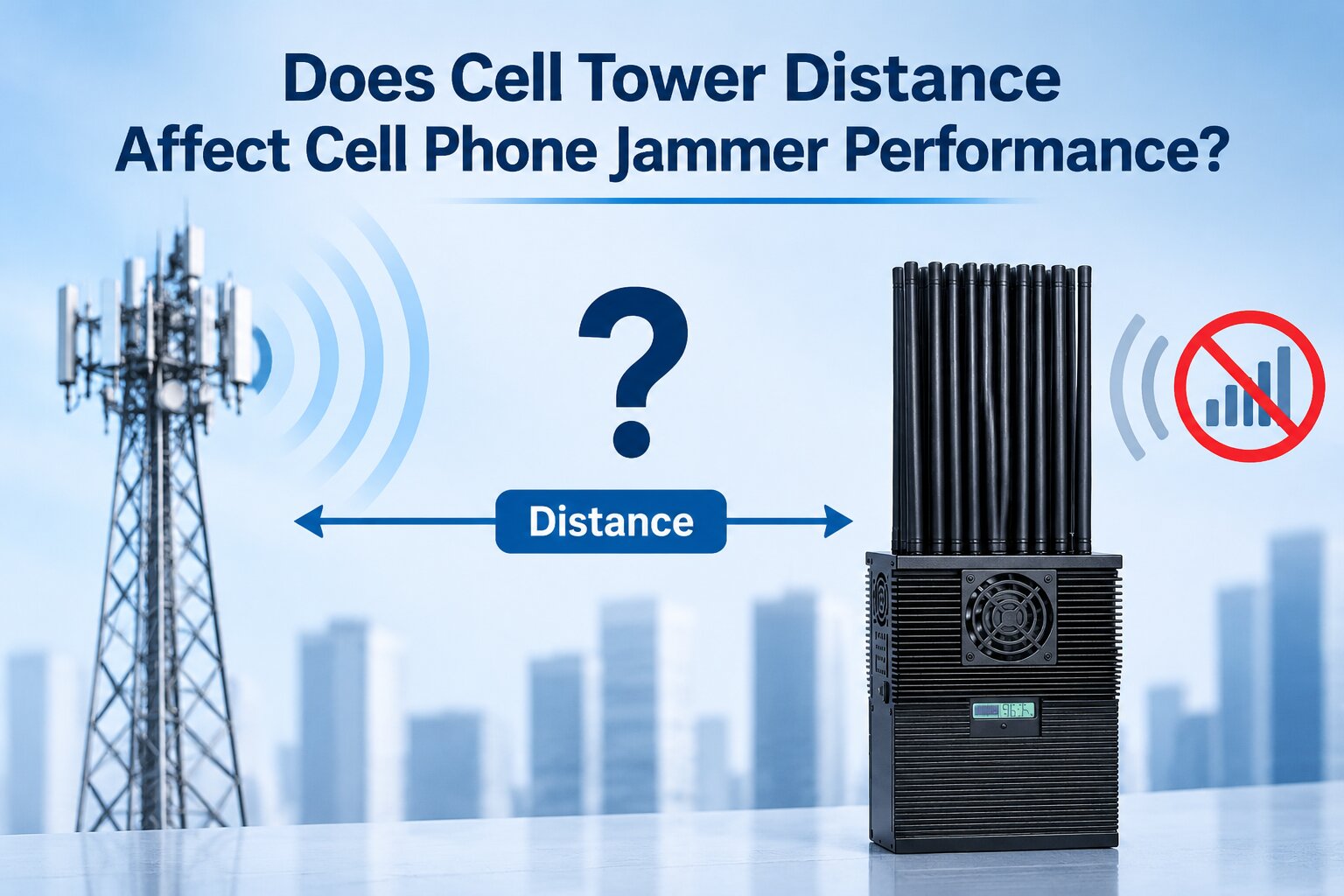
Cell tower distance is one factor that influences the radio environment in which a mobile signal jammer operates.
A nearby cell tower may provide stronger cellular signals, while a more distant tower may deliver weaker signals due to propagation loss.
Generally speaking, the closer a mobile phone is to a base station, the less effective a mobile network blocker may be in achieving its intended jamming effect.
However, the relationship between tower distance and radio-frequency jamming is more complicated than simply measuring the distance between two devices. Signal strength, frequency bands, surrounding structures, and environmental conditions all play a role.
How Cell Tower Distance Influences Cell Phone Jammer Effect
Cell towers transmit radio-frequency signals across designated coverage areas. As these signals travel, their strength generally decreases with distance.
When a mobile device is closer to a tower, its received cellular signal may be stronger. This changes the radio-frequency conditions in which interference occurs.
The important point is that cell tower distance alone cannot determine the effectiveness of a 32 bands cellular phone jammer. The relative strength and quality of received signals are also important.
Three Factors Affecting the Effectiveness of Wireless Signal Blocking
Besides tower distance, several environmental and technical factors influence cellular radio conditions.
Factor Influence on Radio Signals Signal Strength Determines the received power of cellular signals. Frequency Band Different frequencies have different propagation characteristics. Building Materials Concrete, metal, and reinforced structures can attenuate radio waves. Environmental Conditions Terrain and surrounding structures affect signal propagation.
Why Distance Alone Cannot Explain Mobile Signal Blocker Performance
Two locations at the same distance from a cell tower can have very different radio-frequency environments.
Consider these examples:
| Location | Radio Environment |
|---|---|
| Open Outdoor Area | Fewer physical obstructions. |
| Concrete Office Building | Greater indoor signal attenuation. |
| Underground Parking Garage | Significant structural obstruction. |
| Dense Urban Neighborhood | Multiple buildings and radio sources. |
Therefore, the closer a mobile phone is to a base station, the more the effectiveness of a mobile sim network jammers will be diminished.
This is because the signal the phone receives from the base station is relatively strong, and the signal emitted by the cell phone scrambler device must compete against it.
Of course, this is not the only factor; the radio frequency (RF) environment—influenced by elements such as physical obstacles or concrete office buildings—also plays a role.