
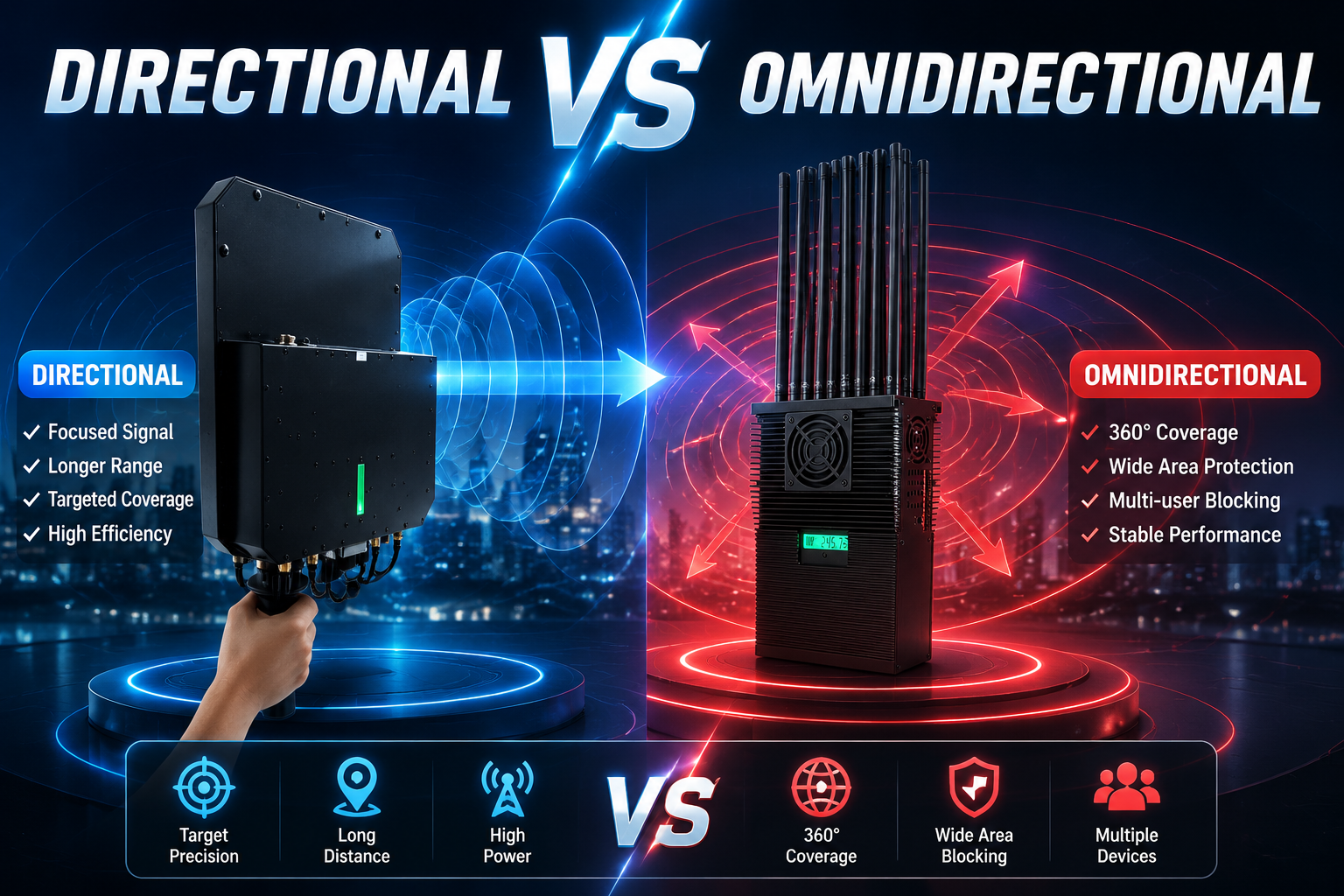
A signal is never just “on” or “off”—it behaves like traffic in a city.
Think about a busy city intersection at rush hour. Some roads spread traffic evenly in all directions, while others funnel everything into a single highway.
Radio signals work in exactly the same way. The antenna doesn’t just transmit energy—it decides how that energy moves through space. And in signal jammer systems, that decision usually comes down to two core designs: omnidirectional antennas and directional antennas.
Omnidirectional antennas: like turning on a light bulb in a room
An omnidirectional antenna spreads RF energy in all directions, similar to a ceiling light lighting up an entire room evenly.
This is why it’s commonly used in:
- Indoor open spaces
- Multi-direction environments (halls, lobbies, open offices)
- Situations where movement is unpredictable
But here’s the catch:
Like a bulb in a large stadium, brightness (energy density) drops with distance.
Directional antennas: like a flashlight in the dark
A directional antenna works more like a flashlight beam. Instead of lighting everything, it concentrates energy into one direction.
This becomes useful when:
- The target area is clearly defined
- Distance matters more than width
- You want to avoid wasting energy behind or sideways
Think of trying to signal someone across a street at night—you don’t need 360° light, just a focused beam.
So, the real difference is not coverage—it’s energy density
Most comparisons stop at “wide vs narrow,” which is misleading.
The real engineering difference is:
- Omnidirectional = low energy density, wide distribution
- Directional = high energy density, controlled path
In RF terms, it’s not about how far the signal goes—it’s how much of it arrives in one place.
Why jammer performance depends more on antenna than power
Two devices with the same wattage can behave completely differently.
The antenna decides whether power becomes scattered noise or concentrated interference.
That’s why modern RF design treats antennas as part of the core system—not an accessory.
So which antenna actually performs better?
There is no universal “winner,” only different physics goals:
- Omnidirectional = consistent coverage in all directions
- Directional = controlled energy placement
In practical system design, the question is not “which is stronger,” but:
Do you want to cover space, or control space?