
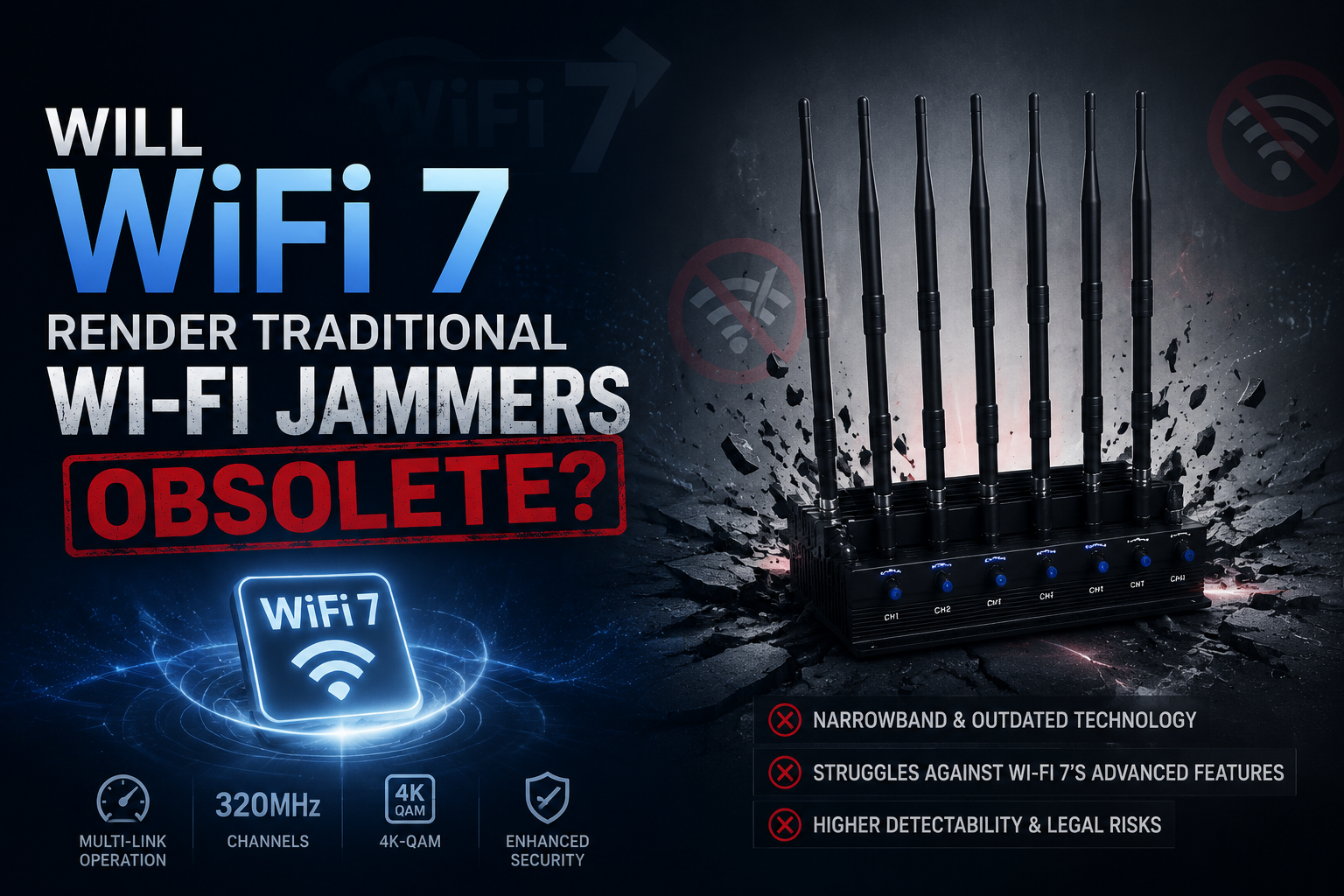
If you only look at the specifications, Wi-Fi 7 seems like a “Terminator version”: wider channels, faster speeds, multi-link concurrency, AI scheduling, 6GHz spectrum extension…
On paper, it feels like a system that should make older jamming devices irrelevant.
But that assumption misses the real point.
Traditional Wi-Fi jammers were never dependent on a specific WiFi generation.
Interference is not a WiFi problem—it is a spectrum behavior problem
A common misunderstanding is to treat jamming as something tied only to wireless signal standards.
In reality, wireless signal is just one participant in a much larger RF ecosystem.
Even in Wi-Fi 7 environments, wireless communication still relies on:
- shared spectrum resources
- time-sensitive transmission windows
- device coordination under load
- fallback mechanisms when conditions degrade
These are physical-layer realities, not software features.
No matter how advanced the protocol becomes, it still operates inside a contested radio environment where multiple signals coexist.
Wi-Fi 7 (IEEE 802.11be) introduces improvements such as Multi-Link Operation, wider channels, and smarter scheduling. These features increase efficiency and reduce congestion under ideal conditions.
However, from an interference perspective, the effect is not “immunity”—it is redistribution.
Instead of a single predictable link, modern wireless network systems now rely on:
- multiple simultaneous connections across bands
- continuous switching between channels
- dynamic fallback when performance drops
- tighter timing coordination between devices
This makes the system more adaptive, but also more sensitive to environmental instability.
In other words, Wi-Fi 7 does not remove interference behavior—it spreads it across more variables.
Why traditional jammers are not “obsolete,” but context-dependent
Traditional network blockers are often evaluated too narrowly, as if their relevance depends only on disrupting a single protocol.
But real-world wireless environments are not single-protocol systems.
Even in advanced deployments, large portions of traffic still rely on:
- legacy wireless signal modes (Wi-Fi 5/6 behavior inside mixed networks)
- single-band or fixed-band IoT devices
- fallback connectivity paths under congestion
These elements do not operate with the same level of coordination as Wi-Fi 7 devices.
As a result, interference impact does not disappear—it behaves unevenly across the network.
You can also learn about WiFi 6E & WiFi 7E: The Hidden Revolution Behind Your Wireless World.
Some links adapt quickly, while others remain structurally vulnerable to environmental disruption.
Today’s wireless landscape is no longer defined by wireless signal alone.
A typical environment may also include:
- Bluetooth devices operating in close proximity (2.4 GHz band)
- cellular communication systems (sub-6 GHz and mmWave ranges)
- GPS/GNSS positioning signals (around 1.2–1.6 GHz)
- IoT and industrial RF links across sub-GHz bands
- UWB tracking and sensing systems (3.1–10.6 GHz)
All of these systems share the same physical space and often overlap in time, location, and spectrum usage.
Why “stronger wireless signal” does not mean “no interference impact”
WiFi 7 improves resilience, but resilience is not elimination.
Modern wireless systems are designed to:
- reroute traffic
- balance loads
- switch bands dynamically
- recover from degraded links
But these mechanisms depend heavily on timing, coordination, and stable signal conditions.
When those conditions become unpredictable, the system does not become immune—it becomes more complex in how it degrades.
Instead of simple disconnection, performance issues may appear as:
- unstable latency
- uneven throughput across devices
- inconsistent fallback behavior
- fragmented performance in dense environments
This is still interference behavior—it is just distributed differently.
WiFi 7 does not make traditional Wi-Fi jammers obsolete, because interference was never limited to wireless signal in the first place.