
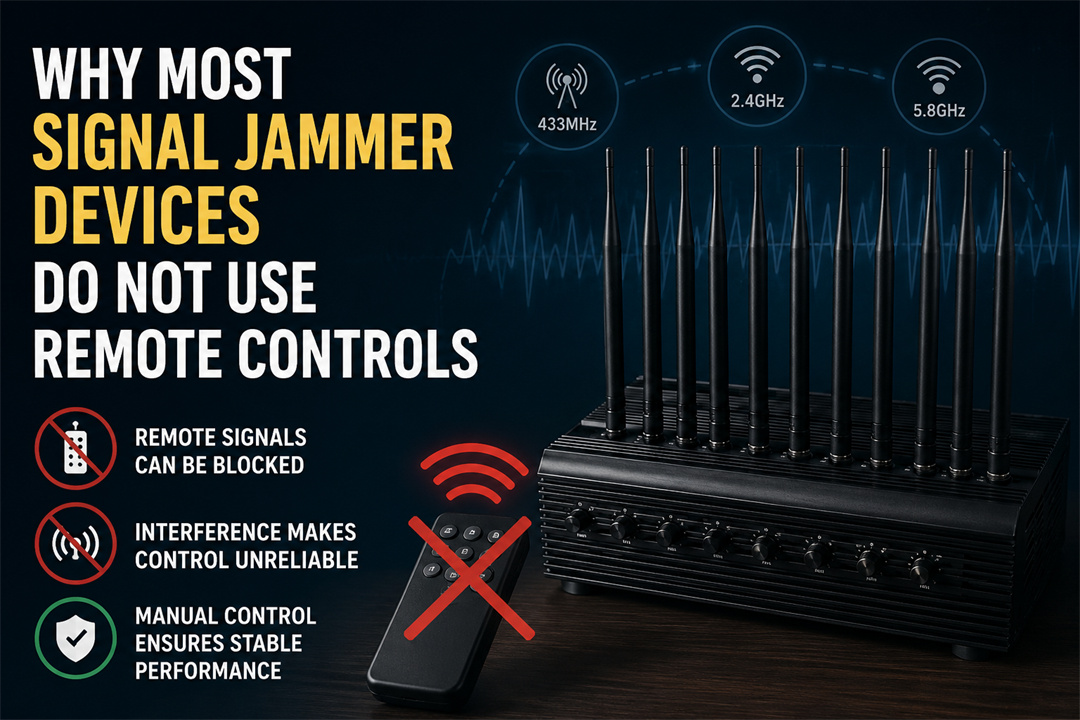
Many people browsing a modern Signal Jammer quickly notice something unusual: despite years of product evolution, very few RF jammers support remote-control switching.
At first glance, this seems outdated. After all, remote controls are common in TVs, smart devices, lighting systems, and even industrial equipment. So why are they rarely used in professional signal blocking devices?
The answer is surprisingly simple: remote controls become unreliable once the jammer starts working.
Why does the signal jammer frequently fail to turn on/off via remote control?
Manufacturers are not avoiding remote controls because of cost or design limitations. The real issue is that a working Signal blocker actively interferes with the same technologies most remote systems rely on.
This creates a technical contradiction:
The RF Jammers can usually be turned ON remotely — but once active, it may block the remote control signal itself.
A jammer powerful enough to block wireless communication can also block its own remote controller.
Infrared Remote Controls: Limited Range & Easy Obstruction
One solution manufacturers tested was the traditional infrared remote control system, similar to TV remotes.
However, infrared control has several limitations:
- Short operating distance
- Requires direct line-of-sight
- Performance drops if objects block the sensor
In real-world installations, many Desktop Signal Jammer units are placed:
- Under desks
- Inside cabinets
- Behind furniture
- In concealed security locations
Once obstacles appear between the remote and the Jamming Device, infrared switching becomes inconsistent or completely unusable.
Wireless Remote Controls vs Signal Blocker Frequencies
Wireless remote controls appear to solve the line-of-sight problem, but they introduce an even bigger issue.
Most wireless remote systems operate on frequencies such as:
- 433MHz
- 2.4GHz WiFi
- 5.8GHz wireless communication bands
Ironically, these are exactly the same frequency ranges many modern multi-band signal jammer devices are designed to block.
Once the device activates, it continuously suppresses nearby wireless signals — including the remote controller trying to communicate with it.
This means users may be able to turn the jammer ON remotely, but turning it OFF becomes difficult unless the remote is moved extremely close to the device.
Why Professional Signal Blocking Devices Prefer Manual Controls
Because of these reliability problems, many professional-grade jammers continue to use:
- Physical power switches
- Independent frequency controls
- Manual band selection systems
While this may appear less convenient, it provides something far more important:
stable and predictable operation.
Reliability Matters More Than Convenience
In practical use, a jammer is often deployed in environments where communication control must work immediately and consistently.
A failed remote signal can create:
- Unexpected downtime
- Delayed shutdown
- Operational confusion
- Loss of signal blocking control
For this reason, many manufacturers intentionally avoid remote-control systems unless they are absolutely necessary.
Could Future Signal Jammer Models Use Better Remote Technology?
Possibly — but the challenge remains fundamentally difficult.
As long as a Jammer Device blocks the same wireless spectrum used for remote communication, interference between the jammers and its own controller will remain a technical limitation.
Some advanced systems attempt to solve this with:
- Wired external controls
- Shielded switching systems
- Separate low-interference frequencies
However, these solutions increase complexity and cost.
Final Thoughts on Remote Controls of Signal Jammer
Remote controls may sound convenient, but in the world of Signal Jammer technology, convenience often conflicts directly with functionality.
The more effectively a jammer blocks wireless communication, the harder it becomes for wireless remote controls to function reliably.
This is why many professional jammers still rely on manual operation — not because the technology is outdated, but because reliability comes first.