
Let’s get straight to it:
If a “privacy device” claims to protect a full room or work reliably at 10–15 meters, you should be skeptical.
Not because all devices are bad—but because physics doesn’t negotiate.
White Noise, Not Blocking: The Core Misunderstanding
Most people imagine Audio jammers as something that blocks microphones.
That’s not what happens.
These Anti-Recording devices don’t disable recording. They don’t cut signals. They don’t “jam” audio in the wireless sense.
They simply add sound.
White noise or ultrasonic energy is emitted into the air. If that sound reaches the microphone at a higher level than your voice, the recording becomes distorted or unusable.
That’s it.
👉 Which leads to a critical implication:
If the noise doesn’t physically reach the microphone with enough strength, there is no protection.
Why 3 Meters Is a Hard Ceiling
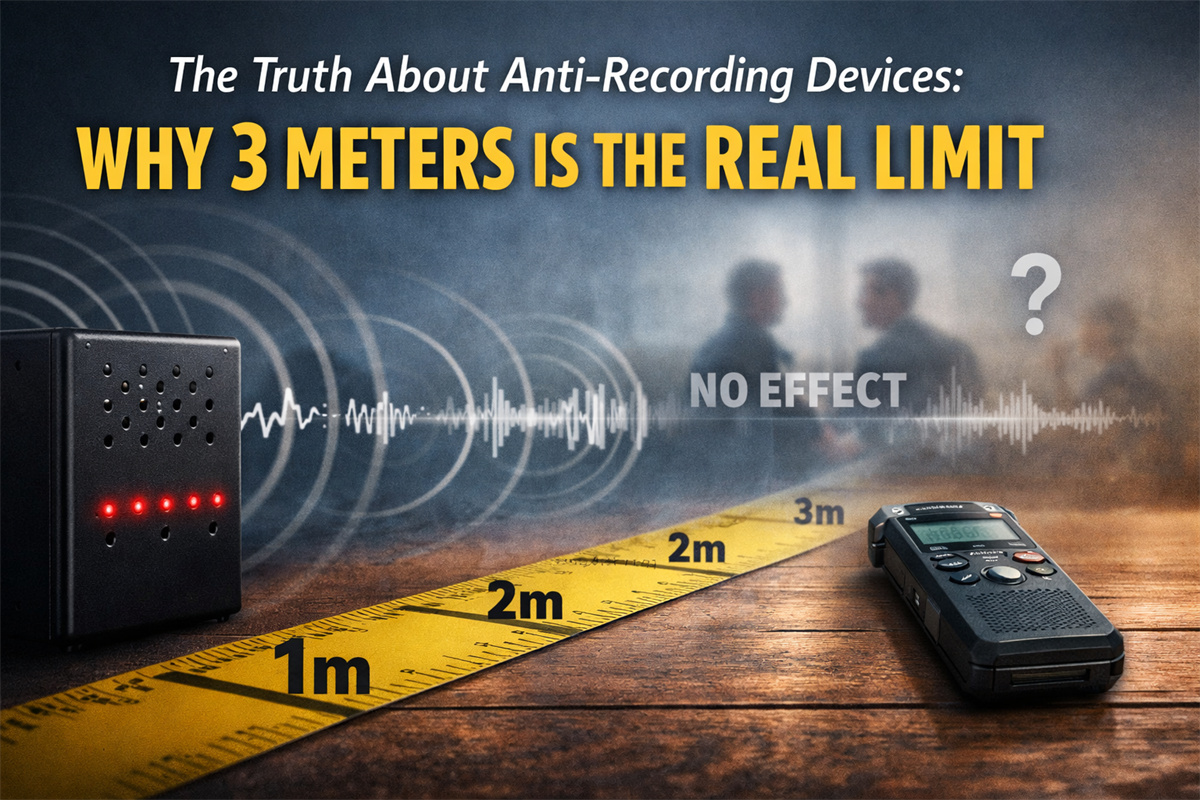
In real-world testing—not lab demos—the effective range of most audio Jammer devices looks like this:
- 0–1 meter → Strong distortion (reliable masking)
- 1–2 meters → Usable interference
- ~3 meters → Edge case, inconsistent
- Beyond 3 meters → Minimal to no effect
This isn’t a coincidence. It’s a direct result of how sound behaves.
The “Extra Meter” Problem: Not Linear, But Brutal
Here’s where marketing and reality completely diverge.
Many assume that if a Jammer device works at 2 meters, it should kind of work at 4 meters.
That’s not how acoustics works.
Sound intensity drops rapidly with distance—roughly following an inverse-square pattern:
- Double the distance → roughly one quarter of the energy
So going from 2m to 4m isn’t “half as strong.”
It’s closer to 75% weaker.
👉 That’s why:
The jump from 2m to 3m often kills effectiveness entirely.
Not gradually. Abruptly.
Why “More Power” Doesn’t Fix It
A common assumption:
“Just increase the output and you’ll get more range.”
Sounds logical. Fails in practice.
Here’s why boosting power hits a wall fast:
1. You expose the device
Push enough audible noise, and people in the room will notice immediately.
Your “discreet protection” becomes the opposite.
2. Distortion doesn’t scale cleanly
More volume doesn’t guarantee better masking—especially against modern microphones with noise reduction and directional pickup.
3. Energy consumption explodes
Portable devices are limited by battery size. Doubling output doesn’t double range—it drains runtime disproportionately.
👉 Bottom line:
Power increases come with heavy trade-offs—and very limited range gains.
The Industry Problem: Inflated Range Claims
So where do “10 meter protection zones” come from?
Usually:
- Empty rooms
- Direct line-of-sight alignment
- Unrealistically high output levels
- Ideal microphone placement
That’s not how people actually use these White noise Generator devices.
👉 In everyday scenarios, those numbers don’t hold.
A More Honest Standard: What You Should Expect
If you’re evaluating an anti-recording device, use this as your baseline:
- Reliable protection = within 1–2 meters
- Anything beyond 3 meters = situational at best
This isn’t pessimistic—it’s realistic.
What Actually Works (If You Care About Results)
Instead of chasing unrealistic range claims, focus on strategy:
- Keep sensitive conversations within a controlled distance
- Position the device close to likely recording points
- Combine placement + environment awareness
- Use multiple units if needed (not one “magic box”)
👉 Because in reality:
Audio privacy isn’t a single device problem—it’s a positioning problem.
Final Takeaway
Audio Jammer can work. Very effectively—within their limits.
But those limits are not defined by marketing specs.
They’re defined by acoustic physics.
And that physics says:
3 meters isn’t a weakness. It’s the boundary.
Anything claiming far beyond that?
You’re not buying better technology—you’re buying a better story.