
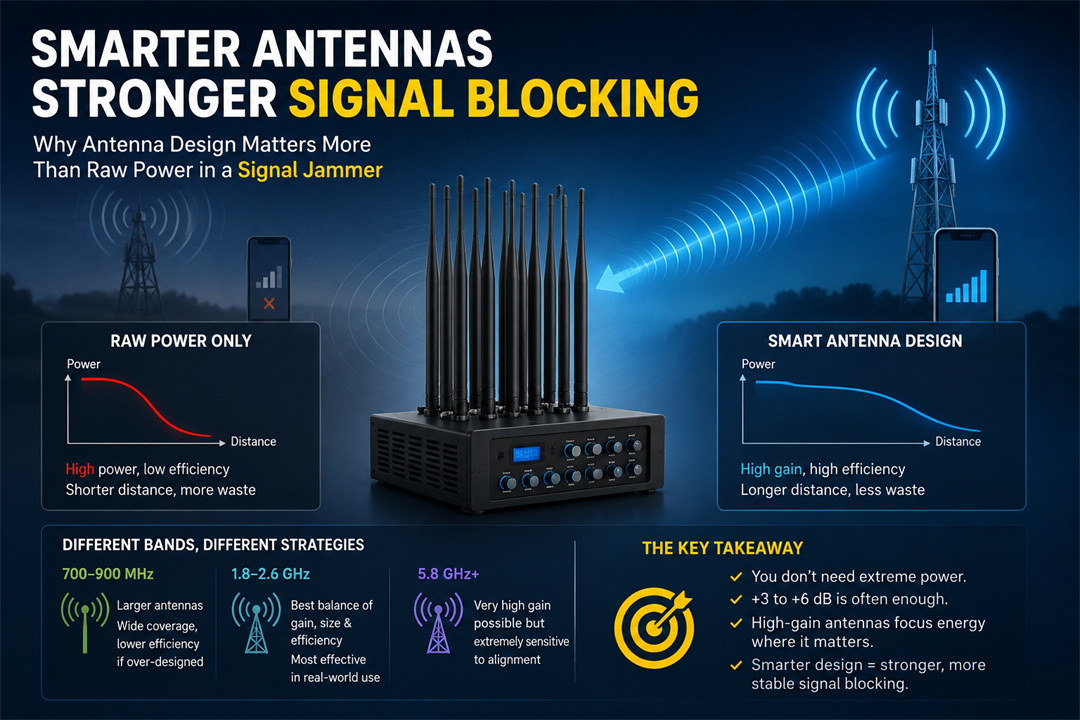
Many buyers searching for a professional Signal Jammer assume that higher output power automatically means stronger blocking capability. In real RF environments, however, brute force alone rarely delivers the best results. A properly engineered mobile phone jammer often performs better through optimized antenna structure, efficient RF distribution, and precise frequency targeting.
Modern Cell Phone Signal Blocking technology is no longer just about increasing wattage. The real advantage comes from how effectively the device controls and focuses RF energy across different communication bands such as LTE, GPS, WiFi, and 5G.
How Mobile Signal Jamming Works in Real Wireless Environments
Contrary to popular belief, a jammer signal does not need to be massively stronger than the original transmission. In many situations, only a small signal advantage is required to interrupt stable communication.
In most RF environments, a difference of only +3 dB to +6 dB is often enough to force devices to lose synchronization with nearby networks.
Electronic devices naturally attempt to connect to the strongest available signal source. Once the Signal Jammer slightly dominates the channel, communication stability begins to collapse. This is why efficient antenna systems are often more important than excessive amplifier power.
A well-designed antenna allows the Cellular Signal Blocker to focus RF energy precisely where it is needed instead of wasting power in ineffective directions.
Why High-Gain Antennas Matter in a mobile cell jammer
A high-gain antenna does not create extra power. Instead, it concentrates existing RF energy into a more focused transmission pattern. This dramatically improves real-world blocking efficiency without unnecessarily increasing heat or power consumption.
In professional Signal Blocking systems, high-gain antennas can:
- Increase effective blocking distance
- Improve directional RF control
- Reduce wasted signal output
- Enhance interference stability
- Lower unnecessary thermal stress
Think of it like comparing a flashlight beam to a bare light bulb — both use energy, but one focuses it far more efficiently.
Low Frequency Signal Jammer Design Challenges (700–900 MHz)
Low-frequency communication bands require larger antennas because of their longer wavelengths. Frequencies such as 700 MHz, 800 MHz, and 900 MHz can achieve excellent coverage, but they introduce several engineering limitations.
Increasing antenna gain at these frequencies often results in:
- Larger antenna structures
- Heavier equipment weight
- Reduced portability
- Greater mechanical stress
- More difficult heat management
For portable Signal Jammer devices, excessively large low-band antennas can reduce efficiency instead of improving it.
This is why many advanced systems prioritize balanced RF optimization rather than blindly increasing low-frequency antenna size.
Why Mid-Band Cellular Jammer Systems Usually Deliver the Best Performance
The 1.8 GHz to 2.6 GHz range is often considered the ideal operating zone for many jammer systems. In this frequency range, antenna designers can achieve stronger gain without oversized hardware.
Mid-band antennas typically provide:
- Better impedance matching
- Higher RF efficiency
- More stable directional control
- Compact antenna construction
- Improved blocking consistency
This is one reason why LTE and common cellular communication bands often show the most noticeable real-world signal jamming performance improvements.
High Frequency Signal Blocking Above 5.8 GHz Requires Precision
At ultra-high frequencies, antenna behavior becomes significantly more sensitive. Minor alignment errors or imperfect impedance matching can dramatically reduce effectiveness.
Although high-frequency antennas may achieve impressive gain values on paper, their radiation beams become extremely narrow.
Even small positioning errors can reduce high-frequency blocking performance far more than most users expect.
As a result, advanced Signal Jammer systems operating above 5.8 GHz require:
- Accurate antenna positioning
- Stable installation conditions
- Careful RF calibration
- Precise directional targeting
Without proper tuning, high-frequency systems may underperform despite having higher theoretical specifications.
Why Smart RF Engineering Beats Extreme Power Output
Increasing amplifier wattage alone creates additional heat, energy consumption, and hardware stress. Beyond a certain point, higher power no longer guarantees better real-world interference performance.
Professional Signal Blocking equipment achieves stronger and more reliable results through:
- Frequency-specific antenna optimization
- Efficient RF energy distribution
- Stable amplification architecture
- Thermal reliability
- Intelligent signal management
A well-engineered Cellular Jammer does not rely purely on brute-force power — it relies on smarter RF design, efficient antennas, and precise frequency control.
In modern wireless environments filled with LTE, GPS, WiFi, Bluetooth, and 5G signals, optimized antenna engineering often delivers better practical performance than simply increasing transmission wattage.