
When shopping for a mobile signal jammer, most buyers fixate on numbers: wattage, maximum range, or the number of antennas. On paper, these specs look decisive. In reality, they rarely tell the full story.
If you want predictable, real-world performance, you need to look deeper. Below are four often-overlooked factors that quietly dictate how well a jammer actually works—whether in a small office or an open outdoor space.
1. Portable vs. Fixed Jammers: Flexibility vs. Stability
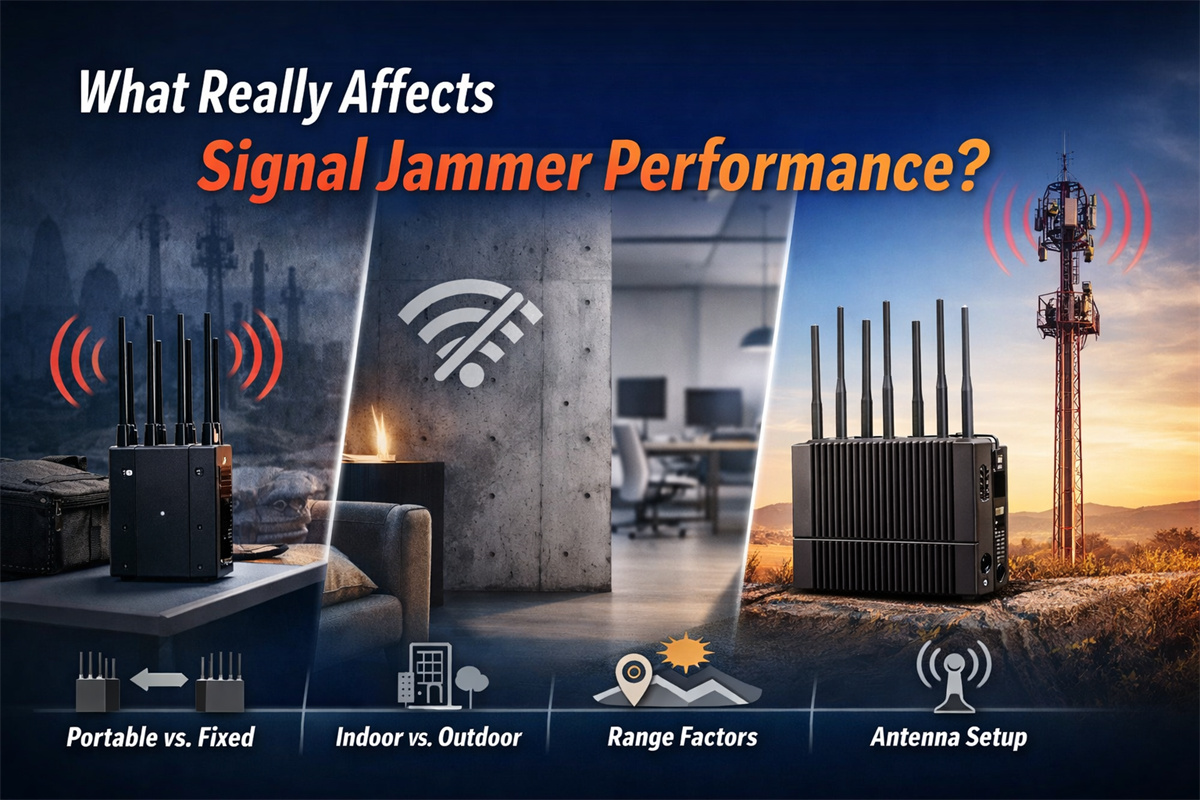
At first glance, portable jammers seem attractive—compact, easy to carry, and quick to deploy. But mobility comes with trade-offs.
Portable jammers are built for short-term, flexible use:
- Lightweight and easy to reposition
- Limited cooling capacity
- Designed for intermittent operation
By contrast, fixed (stationary) jammers are engineered for consistency:
- Continuous power supply
- Advanced heat dissipation systems
- Stable, uniform signal suppression
👉 Key insight:
A portable jammer may deliver quick results, but it cannot sustain the same long-term reliability as a fixed installation.
Practical takeaway:
For environments like offices, warehouses, or dedicated rooms, a fixed jammer is not just stronger—it’s more dependable over time.
2. Indoor vs. Outdoor Use: The Hidden Impact of Physical Barriers
One of the biggest misconceptions is assuming that indoor environments are easier to control. In fact, the opposite is often true.
Walls don’t just block mobile signals—they weaken jamming signals too.
Materials like:
- Reinforced concrete
- Metal structures
- Thick insulation layers
…can absorb or scatter interference signals, leading to:
- Reduced effective range
- Dead zones and uneven coverage
- Wasted transmission power
In contrast, outdoor environments allow signals to propagate freely:
- Fewer physical obstructions
- Broader and more consistent coverage
- Greater effective distance
👉 Key insight:
The same jammer can perform dramatically better outdoors than inside a building.
Practical takeaway:
If maximum coverage is your goal (e.g., parking lots, open facilities), outdoor deployment is far more efficient—or you’ll need a significantly more powerful indoor setup.
3. Why “Range” Is Never a Fixed Number
Manufacturers often advertise a “maximum range,” but this figure is typically measured under ideal conditions. Real-world performance is far more complex.
Actual range depends on multiple variables:
- Strength of nearby cellular towers
- Number of active devices in the area
- Distance to base stations
- Urban vs. rural environment
- Structural interference
This means:
- The same device may cover a wide radius in open terrain
- But struggle significantly inside dense buildings
👉 Key insight:
Range is not a constant—it’s a variable shaped by the environment.
Practical takeaway:
Always plan with a safety margin. In complex environments, expect real coverage to fall short of advertised figures.
4. Antenna Configuration: The Silent Performance Multiplier
More antennas don’t automatically mean better performance. What truly matters is how they are arranged and coordinated.
Effective antenna setup requires:
- Proper alignment (typically vertical for optimal propagation)
- Clear separation between frequency bands
- Adequate spacing to avoid interference
Common mistakes include:
- Antennas placed too close together
- Incorrect angles
- Poor frequency allocation
These issues can cause:
- Signal overlap and self-interference
- Energy loss
- Reduced effective coverage
👉 Key insight:
Smart antenna configuration can significantly boost performance—without increasing power.
Practical takeaway:
Optimize placement before upgrading hardware. A well-tuned setup often outperforms a poorly configured high-power device.
Final Thoughts: Performance Is Context, Not Just Power
Shopping a mobile signal jammer based solely on specs is a shortcut that often leads to disappointment. Real performance depends on how the device interacts with its environment.
To make a smarter decision, focus on:
- Deployment type (portable vs. fixed)
- Operating environment (indoor vs. outdoor)
- Dynamic conditions affecting range
- Antenna configuration and layout
👉 Bottom line:
The best jammer isn’t the one with the highest advertised power—it’s the one properly matched to your real-world scenario.